
Apple and Amaranth Granola

At this time of year I struggle for breakfast ideas. It’s not cold enough for porridge and I find it hard to get the lovely plums and greengages the season offers so find my bowls of bircher muesli less alluring without a fruity topping. I need something to shake me up a bit and hopefully wake me up a bit as well. The bite of granola seemed to fit the bill.
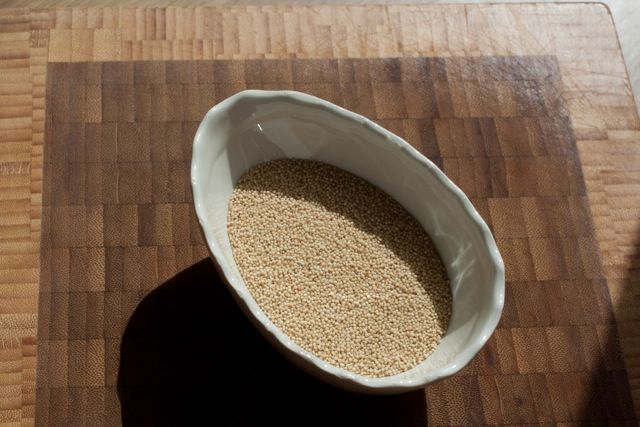
Raw amaranth grains

I’d been wondering what to do with the amaranth I’d impulse purchased at Whole Foods a while back and decided that a granola might lift it from looking like birdseed to something more appetising. As terrified to get it wet as Zack should have been with his Mogwai in Gremlins after hearing it goes gluey, I popped it in a hot pan first, turning it from plain seed to toasty treat.

Popped amaranth seed

Amaranth is an ancient grain (from a grass I believe) and is similiar to quinoa in that it is gluten free* and high in protein and fibre. It makes interesting sounding porridges, but I think it most appetising dry cooked to keep it nutty and crunchy. Bearing in mind that the seed is so crunchy, I decided to make the rest of the granola a little bit softer by coating it with stewed apple instead of oil. Everything about this recipe was impulse based so it’s in cups, not weights.

Apple and Amaranth Granola:

  • 2 apples, stewed down to make one cup of apple puree
  • 2 cups jumbo oats
  • 1/2 cup amaranth
  • 1/4 cup wheatgerm (optional if your granola is wheat free)
  • 1/4 cup sesame seeds
  • 1/2 cup pumpkin seeds
  • 1/2 cup pecans, halved
  • 1/2 brazil nuts, halved
  • 1/2 cup honey (or treacle)
  • 1/2 teaspoon ground ginger
  • 1/2 teaspoon grated nutmeg

First, stew your apples. Back in Belfast where I made this, it’s dead easy to get proper Bramley apples for cooking, but I struggle to find them in London, so just use anything sharp and tangy. Peel, slice finely, add about a tablespoon of water and stew until soft and like a puree. They’ll collapse in on themselves if left at the lowest heat with a lid on for about 20 minutes.

Then using a hot dry pan, toast your sesame seeds and set aside. Have a lid handy and then into the same pan, put your amaranth and toast until about 40% of it looks like tiny white popcorn and the rest is golden brown. It won’t all pop, but what does will go everywhere so you’ll need that lid!

Place all your dry ingredients in a bowl. You can add more types of nuts if you like. Hazelnuts would be lovely. Some flaked coconut is fabulous. You could add in some linseeds or sunflower seeds. Play around to get your perfect mix. Heat the pureed apple and the honey together and then mix into the dry ingredients, mixing well to make sure they are all coated.

Cook on a shallow tray so the granola is well spread out in the oven at 200℃ for about 20 minutes. Turn it over at this point and give it another 10 minutes until golden and crispy looking but not burnt. Cool in the tray and put in an airtight container immediately as this granola is a bit softer than oil based ones and will wilt gently if left out for too long.

Eat clusters of it with your bare hands while doing so or wait until you can get it into a bowl where it is fabulous with fresh berries and yoghurt. Healthy and filling, this doesn’t taste wholesome or lacking in flavour. The amaranth is nutty and packed with flavour and the chunky nuts make this feel very luxurious indeed. Considering it takes so little time to make, I’ll definitely be doing this again instead of spending serious money on boxed mueslis or granolas. Their packaging migh look nice on the table, but you don’t get to pop your own ancient grains with those….

*this whole granola can be gluten free if you choose oats that guarantee themselves GF in processing. See the Coeliac Society for more info from people in the know.

Ginger and Marmalade Flapjacks

When I first started baking three or four years ago I started out with flapjacks, having heard they are so simple you can even let the kids make them. They sounded foolproof. I quickly proved that wrong with several batches being so bad even the local birdlife passed them over in favour of some fried chicken bones on the path. Reminded to never to make my ungrateful feathered friends those lard and seed things Blue Peter used to tell me about, I have been in a sulk with flapjacks ever since.

An impromptu visit to The Beanery in Loughborough Junction the other day piqued my interest again with their delicious ginger flapjacks. The warm tingle of ginger lifted the oats nicely, but made with that American upstart corn syrup instead of good old British golden syrup, they lacked the stickiness I crave in a flapjack. There was nothing else for it but to try and make my own. I decided to use syrup and add the gooey-ness of a blob of homemade marmalade to really give my teeth something to sink into.

Excited by this flavour combo, but still nervous there would be a repeat of the Massive Crumblings™ of yore, I needed a failsafe recipe and safe hands. I turned to Felicity Cloake and her Perfect series, reading her recipe and all the comments from flapjack lovers underneath. It looked promising.

Ginger and Marmalade Flapjacks (adapted from Felicity Cloake’s recipe)

  • 150g salted butter
  • 3 tablespoons golden syrup
  • 2 tablespoons dark muscavado sugar
  • 3 tablespoons marmalade (pop a bit more in if it’s very coarse cut)
  • 4 teaspoons ground ginger
  • 250 g porridge oats
  • sliced stem or crystallised ginger

Line a tray (I used a 23cm by 23cm one) with greaseproof paper and preheat the oven to 150℃. Melt the butter, sugar and golden syrup together until bubbling gently, then add in the marmalade and as soon as it is melted, take off the heat. Put the oats and the ground ginger and sliced ginger in a bowl and add in the butter-syrup mixture, stirring well. Once you’ve marvelled at how seemingly healthy oats soak up butter like a hungry sponge, spread the mix out in the tray well, making sure you fill the corners properly. Bake for 25 minutes. I took mine out when they were still a bit anaemic looking but they darkened as the residual heat cooked them a bit more outside the oven.

Cool for about 5 minutes, then cut into pieces. I got 9 ‘I’m going on a ten mile hike’ sized chunks or 16 ‘just a mouthful ones’. I then on Felicity’s advice left them to cool completely in the tray to stop them falling apart when lifted out. The wait nearly defeated me but I was rewarded by a nice symmetrical traybake which was delightfully firey with ginger and tangy with marmalade peel and slivers of candied ginger. Best served with a cup of good strong tea, they will theoretically keep well in an airtight container, but bolstered by my first ever flapjack success, I failed to have any notable leftovers. The flapjack jinx is over!

Simnel Cake Ice Cream

Simnel Cake ice cream

I am not religious, but I do enjoy all the major Christian holidays, chiefly because they are all held together with copious amounts of marzipan. I love marzipan. I’m that person that will eat the spare almond paste off your Royal icing when you’re defeated by Christmas cake or buy a block of it to eat slices off. And don’t get me started about those exquisite little fruits modelled from the stuff you get in posh grocers and Fortnums. I am definitely in the pro-camp.

I spend a lot of time wanting to increase the ways I can get marzipan into my life, so Easter and its siren song of Simnel cake pleases me hugely. I toyed with these mini ones from Nutmegs Seven which look light as a feather, but I’ve also been fiddling around with trying a marzipan ice cream for ages and suddenly it came together and I realised my world needed Simnel cake ice cream immediately.

You could of course bake a Simnel Cake and break it up into homemade ice cream and bob’s your uncle, but I have a deep shuddering hatred of wet cake. Things like trifle and tiramisu make me feel funny inside. So I needed something more deconstructed, but simple and I think, with this recipe, I’ve cracked it:

Read more

Rhubarb and custard tarts

Angled plate1 new

I love custard of any description. Whether it be Bird’s or Ambrosia’s Devon kind or fresh stuff poured over a crumble or a quivering baked version, I love custard. Sadly it has never reciprocated that love and everytime I’ve tried to make it, there have been problems. It’s split, ended up scrambled, been full of lumps and the packet version has resembled concrete. I’ve always thought if I wrote a book about my cooking exploits, it would be called ‘Custard is my Nemesis.’

Few things go better with custard than rhubarb so when I finally got my paws on some proper Yorkshire forced rhubarb for the first time this season (even though Mister North has been cooking up a storm with it for a while now this winter.) I decided that come hell or high water, this weekend would be the time that I tamed custard, even if it meant the kind of mayhem in the kitchen that accompanied the cartoon duo of the same name.

I’ve been eyeing Dan Lepard’s Bay Custard Tarts forever, even having cut the recipe out of the Guardian and kept it when it first appeared several years ago and thanks to the clear and foolproof instructions in Short and Sweet, I knew this was the place to start with custard, but decided to put a seasonal twist on it by layering the baked custard with a topping of tangy rhubarb curd, partly because it would no doubt be delicious, but because it might hide a custard malfunction…

I made the tart cases from scratch using Dan’s sweet shortcrust recipe and tips on pastry handling. The first time I made pastry it was exceptionally good and I wondered why people worry about it, but every subsequent time has been a mess of varying levels. I decided to try and teach myself better pastry skills while I was mastering custard, but you could just use shop bought if that’s easier. But do follow Dan’s tip to only blind bake the cases for 15 minutes and undercook them slightly to allow the custard to ‘stick’

Read more

Warming winter insulation

Squash and cauliflower soup

Ah, how I love the simple, comforting nature of a good home-made soup on a cold day. As the mercury’s plunged again this week after the unseasonal warmth over Christmas and New Year, I’ve been slipping back to the wintery cycle of roasting, making stock, and then cooking up quick and delightful vats of soup. As well as being a simple, wholesome task, it’s also a great way of using things up in the kitchen.

I rarely follow recipes for soups… you can’t go far wrong with most combinations as long as you use your taste and nose… although an exception to the rule was a fabulous Butternut Squash, Ginger and Apple soup. This was from my favourite Parlour Café Cookbook (which has just been awarded ‘Best First Cookbook in Scotland’ at the Gourmand World Cookbook Awards… congratulations!) and was sweet, velvety and savoury all the way. Generally though, I make it up as I go along, but when the results are really good, I do note them down… so here are a couple I’d like to share.

One lazy Sunday lunchtime a couple of weeks ago, when it was freezing outside and the kitchen windows were all steamed up, I decided we needed some warming soup. We’d had a gloriously rich evening meal the night before, so something a little more simple was the perfect foil to this.

I’d bought one of those cute wee striped squashes around Halloween, and it had sat patiently on the sideboard, imploring me to use it in something. Squashes are great emergency food, lasting for ever. Today was its calling, so I cut it into eighths, and placed it and the florets of about half a cauliflower head on baking tray, drizzled some olive oil over the top, and placed it in a mid-temperature oven (the oven had already been on for a spot of baking a quick wheaten bread.)

Cauliflower and squash

Cauliflower’s been making a comeback in Mister North’s kitchen recently. When we were kids cauliflower only came in two ways: boiled (normally something we’d have at our granny’s) or as cauliflower cheese. I loved both, but it’s a veg which I realised I’d been sorely neglecting when the Hairy Bikers shone a spotlight on the humble cauli in the first series of the Great British Food Revival. I’d made a cauliflower purée the night before, so had a spare half a head to use.

As the veg was lightly roasting, I sweated down some shallots in butter, then added a couple of chopped potatoes to soften. Braving the rain, I nipped out and cut a good sprig of rosemary off the bush; washed it and threw the leaves into the pan. Everything sizzled and softened – the heady aroma of rosemary oil and shallots pervading all of downstairs – and once the spuds felt soft to touch, I threw in five home-made hare stock cubes. Some cooks think life’s too short to make stock ice cubes, but for me it’s a boon to be able to lay my hands on a selection of real stock in small, easy-to-measure quantities.

Taking stock

By then the veg in the oven was looking and smelling pretty fine too, with the cauli florets taking on just a hint of roasted colour, so they got tipped into the pan while I cut the skin off the squash and cubed it. Stir it up, simmer it down. A good shake of smoked paprika was next, the warming scent wafting up from the pan. Finally a decent splash of double cream, and a quick garnish, using up the last of the garlic chives which had grown lackadaisically on my windowsill since late spring, added a flash of colour. I paired it up with some freshly-baked wheaten bread, still warm from the oven: just perfect for wiping the bowl clean.

Winter soups 4


A couple of days later I bought a duck from Lidl – specifically so I’d have a decent stash of duck fat for roasting veg over Christmas – roasted it simply, made a load of stock from it (which set into the most wonderful lustrous thick jelly) and enjoyed the meat in sarnies. When that was suitably diminished I used up the rest in one of my standby big noodle soups: duck, rice noodles, cucumber, carrot and spring onion, shot through with star anise and chilli.

Duck noodle soup

And finally, here’s one of my favourites. When I posted this a few weeks ago on Twitter, the consensus was that it’s not worth making your own, as the tinned version is just perfect. Just add a swirl of cream or a knob of butter, and a generous helping of freshly ground black pepper. What is it? Heinz Cream of Tomato Soup… a true taste of childhood and still one of the best quick standby meals I can call upon…

Winter soups 1