Yellowman meets yellow butter…

Having invited some friends to Sunday brunch, I wasn’t quite sure what to make. Combining two meals into one raises the stakes somewhat and a rubbery fried egg and some cold toast wouldn’t cut it. So I googled brunch ideas and the clear winner was this Bill Granger recipe for ricotta pancakes with honeycomb butter. Soft fluffy pancakes with sweet crunchy butter sounded just the ticket and offered the perfect opportunity to educate my English and American guests about proper yellowman instead of this honeycomb malarkey…

Yellowman is the Irish name for this aerated sugar creation you probably know as the middle of a Crunchie bar or possibly as cinder toffee. It is famed throughout Ireland and particularly associated in the North with the famous Auld Lammas Fair in Ballycastle around the end of August. Paper cones or pokes of yellowman were served at the fair, traditionally accompanied with the famous dulse or dried seaweed. Perhaps an Irish precursor of the salted caramel trend we all know and love now, I found this combo utterly revolting as a child. Dulse had the texture of shoe leather dipped in salt and I could never understand why people brought it back from Ballycastle for us. I already hadn’t been on holiday, why punish me further? I might feel differently these days though.

I loved yellow man though with its sticky rough crunchy feel and glorious sunny colour reminiscent of late summer sunshine and long weekends before school started again. Skipping the side dish of dulse and adding it into butter sounded like improving on something already pretty perfect. Filled with the warm glow of childhood memory and refined sugar, I decided I would live dangerously and make my own yellowman for this recipe as I remember people making it when I was a child and saying how easy it was.

Seeking Irish expertise, (and soundtracking the event with the tones of Jamaica’s finest and appropriately named reggae artist Yellowman) I decided to follow Niamh’s recipe at Eat Like a Girl especially as she omits the butter some recipes use. I’m nervous enough round molten sugar without potentially burning butter to boot. Warned to use a deep pan, I got the Le Cresuet out and started melting. Unfortunately because I am incapable of reading recipes correctly at the moment, I used 200 ml of golden syrup instead of 200g so may have had too much in the mixture, which is why when my trusty thermometer said the mixture had reached the magic 150°C or hard crack stage, the whole thing had gone from an alluring golden amber to burnt umber. I bunged the bicarb in anyway and was unprepared for how much it foamed up. Unsure whether I was meant to stir (ie: put my hand near boiling sugar that is exploding) my hesitation meant there was yellowman mix all over the cooker and even belated stirring didn’t help that much. I poured the remaining mix into a lined tray and set about scraping the sugar off the cooker. I certainly know why the Scots call it puff candy

Sampling a bit left on the pan, I established that the sugar had gone from sickly sweet to acidic and overcooked. I decided to start again, using the correct amount of golden syrup this time. Thinking this is where I’d gone wrong, I followed the recipe exactly otherwise, again going for the hard crack stage and ending up again with darker looking sugar than I’d have liked. I added the bicarb, stirring like a dervish and although it puffed up like a more alluring indoor firework, the yellowman still didn’t look sunshine yellow. In fact eagle eyed readers will have noted that it is in fact that the kind of burnished hue usually only seen on a contestant on Snog Marry Avoid. It also had the same acrid tang of burned sugar as the previous batch.

Having run out of refined sugar products to ruin and acutely aware I was spending my Saturday night in a fog of sticky smelling smoke, I gave up at this point and turned my attention to washing up both sugar caked pots I’d used, realising I should have taken the mix of the heat before it got to the hard crack stage and see if that helped. I also discovered when ruining another recipe later in the week, that I am reading the thermometer wrong! So please don’t be scared to try this recipe unless like me you paid no attention in science class and can’t read a thermometer.*

I then went out the next morning and bought a four pack of Crunchies, denuding them of chocolate with a sharp knife and then mashing them into some softened (and thinking back to the dulse, salted) butter before shaping into a roll and chilling for a couple of hours in the fridge.

Once the guests arrived, I turned my attention to the pancakes. Despite the seemingly complicated two step batter, these are incredibly easy to make and quicker than a regular batter as they don’t need to sit. Spoonfuls of the thick yet light batter went into a hot pan and puffed up beautifully as they turned golden brown. Served up alongside some crisp streaky bacon, these little pancakes were pretty perfect as they were. But adding in the butter took them to a whole new level.

Flecked with shimmering jewels of honeycomb, the butter added a soft yet crunchy, sweet yet not sickly layer of deliciousness to the pancakes. Combining the best of the world of the whipped style butter and syrup the Americans serve with pancakes, you no longer have to choose between the two toppings, but enhance them by creating the best butter in the world. The crunch worked perfectly with the soft pancakes and the sweetness took the bacon up a notch too. There were no pancakes left and only a scraping of the butter once we’d all finished, even though we also had light crumbly corn muffins and a slightly spiced berry compote on our plates too.

Once my guests had left, I finished off the butter on the leftover muffins and reminded myself that it was so good, it had been worth all the fluffy faffing with sugar and syrup the night before. I will be trying making yellowman again instead of trimming a million Crunchie bars, so that I can make an entire block of the butter and then eat it with a spoon. Or make the best toast in the world. Don’t make the pancakes without it. It’s so worth the extra effort!

*I’d also like to thank Niamh who took time out to see if she could help me sort my problem with the yellowman despite me slightly slandering her poor recipe’s good name. I feel very reassured now.

Crimp, rocket and roll… salmon ravioli

This weekend saw the latest round of our longstanding local dinner circle: an informal gathering of friends to enjoy good food, drink and conversation around a table. We’ve previously themed each event around a country or geographical region, for both food and drink. It was my turn to host again and I decided to combine Italian influences with locally sourced ingredients. Perhaps unwisely I decided to set the bar rather high, and make a meal from components bought on the day from the market, in a way I’d never cooked before. Nothing ventured, nothing gained, I suppose.

The first course was my most ambitious, and allowed me the chance to try out something new which would hopefully be as pleasing on the eye as the palate.I ended up with home-made giant ravioli, filled with fresh lemon, salmon and local East Lee soft cheese, served with a fennel and vermouth hollandaise foam on a bed of rocket, and topped with pickled samphire and Morecambe Bay potted brown shrimps…

When Miss South and I were young there were few kitchen activities which beat the excitement and spectacle of making fresh pasta. The large kitchen table would get dusted with flour, a broom handle which was reserved for the occasion would be brought out from under the stairs, and would be placed across the back of two chairs, ready to hang and dry fresh tagliatelle. Finally the pasta making machine would be clamped to the table, ready to pummel, roll and cut.

There was palpable anticipation and excitement in our house, as these activities inevitably heralded a dinner party for the adults – an exotic and adult activity from which we were normally excluded, predominantly as they went on way past our respective bedtimes. However this didn’t preclude us from either hanging around as the pasta was being made, nor sampling it later on. Little would stop me from enjoying the pasta in any way, and I used to snaffle leftovers of the cooked, ungarnished linguine straight from the pan. Sorry mum, if you ever wondered where it disappeared to…

Strangely, despite my love of fresh pasta, I’d never attempted to make it myself. However, with the advent of the dinner circle, I rather fancied rectifying this gap in my culinary canon. So, on a wee bit of a whim, I picked up a pasta maker on the way home on Friday evening (at £17.99 thank you Argos). I suspect when our parents had brought back one from Italy in the 80s it would’ve cost significantly more, if it was even possible to source one in Northern Ireland back then.

I consulted my two favourite Italian authorities for all things kitchen-related: Marcella Hazan, and Giorgio Locatelli. Perhaps unsurprising there was some contradiction in their advice. This pasta-making business seems at least partly based on personal preference. The basic components were, thankfully, consistent – flour, eggs and salt. Previous pizza-making escapades ensured I had plenty of finely-milled ‘Tipo 00’ flour squirrelled away at home, but I picked some duck eggs and some double-yolkers from the market on Saturday morning. Locatelli subscribes to the ‘more yolks are better’ school of thought, and as we’re such a fan of duck eggs here at North/South Food I thought I’d take advantage of their renowned attributes for baking and see if that would apply to pasta dough too.

After finely sieving around 500g of flour I made my ‘fountain’ for 3 duck eggs (reminded me more of the way we eat champ) and got mixing. At first the dough was really hard work and I thought I’d got the mixture all wrong, but after adding an extra hen’s egg double yolk and about 10 minutes of heavy going, the dough started to come together more as I remembered it. The duck eggs helped imbue the dough with a wonderfully warm hue (with more than a passing resemblence to polenta). I then separated the dough into 2 balls, and wrapped both in clingfilm to sit for an hour. Thankfully the dough was much easier to work after it had sat around doing nothing… so I got out the shiny new pasta making machine and tentatively fed the dough into its waiting maw. As the dough got thinner and longer, and longer and thinner, I was glad of an extra pair of hands to assist with the increasingly giant lengths. Eventually it was tamed and fine enough to be laid out on the table to cut.

We cut out large circles, trimming gently around a bowl, then added the filling. I’d finely sliced a fresh salmon fillet (from Paul, the great fishmonger at Todmorden Market), mixing it by hand with some of local food hero Carl Warburton’s East Lee soft cheese. Add the juice of half a lemon, a good portion of zest and a generous handful of chopped flatleaf parsley; some coarsely ground black pepper, and mix up by hand. Form into patties and place in the centre of the pasta circle, before enclosing, sealing and crimping. These sat for an hour on a tea towel, looking pretty drying slightly, ready for the pan. When they were almost ready I started to make the sauce, a variation on Delia Smith’s always reliable foaming Hollandaise. I used less wine vinegar and added a generous glug or three of vermouth just before adding the egg whites, which gave the whole thing a hint of anise. Not quite a béarnaise sauce, but the addition of some fennel tops, finely chopped like dill, added to its slightly aromatic character.

After poaching the ravioli for about four minutes each they were ready to be placed in a bowl, on a star of rocket, and drizzled generously with the foaming sauce. The crowning glory was a garnish of pickled samphire (from the wonderful Brixton Cornercopia, courtesy of Miss South) and some potted brown shrimps from Morecambe Bay. Incidentally, if you’ve not had these little beauties before, snap them up if you’re lucky enough to spot them. They’re so moresome and flavoursome, but not worth the fiddle and faff of preparing them yourself. The dish did look at least as beautiful as I’d planned, and the combination of flavours was balanced and delicious. Thankfully it was also well received by my dinner guests. Phew!

The next day, buoyed up by the success of the ravioli, I used up the rest of the pasta dough and quickly created some tagliatelle. This provided the basis for a rapid leftover lunch to die for: sautéing some fennel in butter, adding some pieces of salmon and the rest of the shrimps, a splash of lemon juice to help wilt the rest of the rocket leaves, and a squirt of harissa to add warmth. This certainly helped to temper the fluffy head from the previous night’s drinking, and underscored that pasta making is nothing to be afraid of. I will be attempting much more of this in the near future… can’t wait until the wild garlic season comes round so I can make fresh pesto and spaghetti!

Semlor

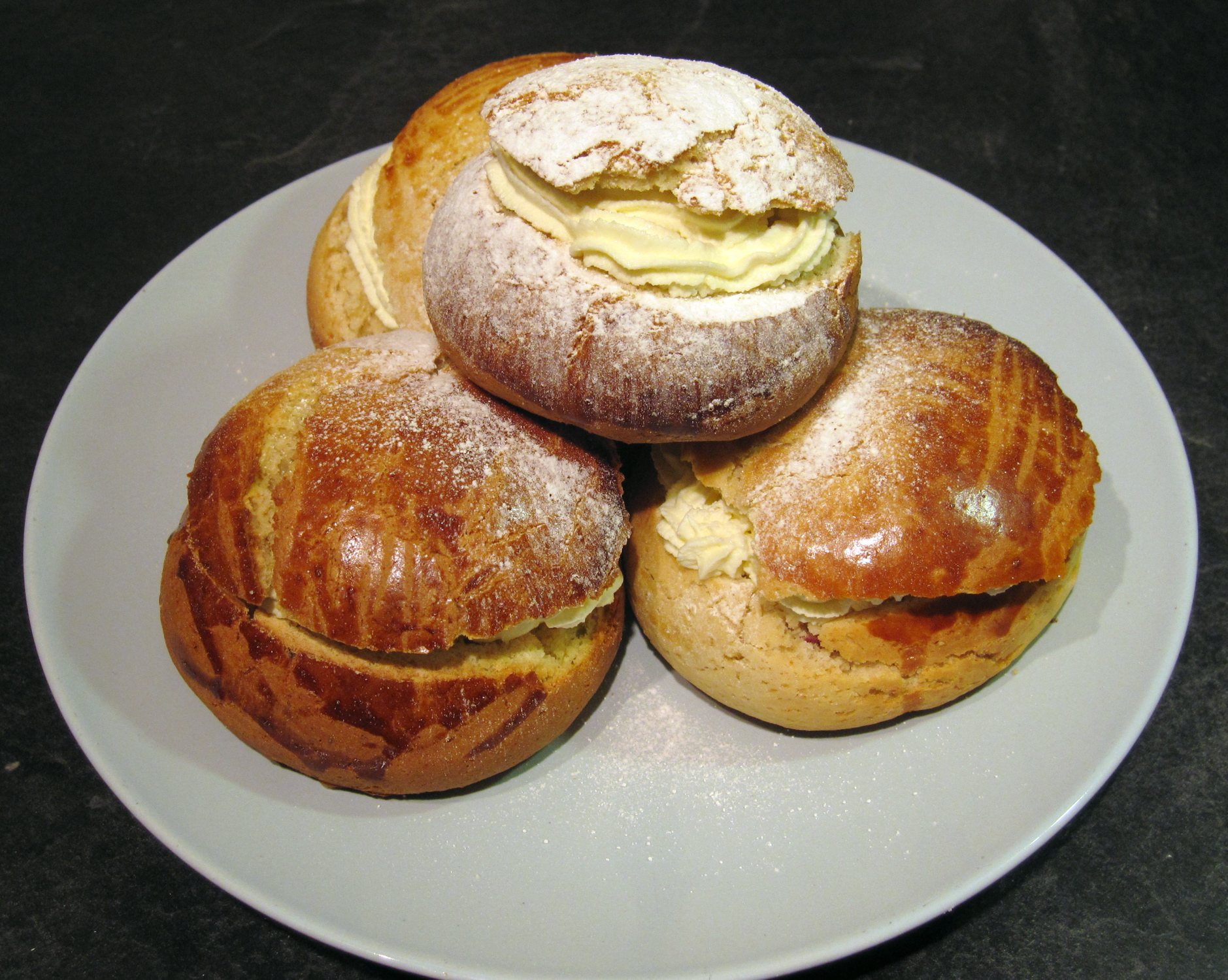
Semlor, or Mardi Gras with marzipan…

After a very long wait since Easter is so late this year, Fat Tuesday finally rolled round this week with its myriad delicious ways to use up rich or fatty ingredients and shrive in time for the start of Lent. Most people went for the always excellent pancake as their Shrove Tuesday treat, but after my recent trips to Scandivanian Kitchen, I decided to celebrate with the Swedish favourite of the cardamom infused, marzipan stuffed and cream filled buns known as semlor. Made with fresh yeast and similar in texture to a doughnut, these chewy soft buns are perfect with a strong coffee and could be sampled in the afternoon, leaving plenty of room for a pancake fest in the evening…

Scandinavian Kitchen are a one stop shop for these little beauties, supplying both the recipe and all the ingredients for them in one place. I stocked up on fresh yeast there for the amazingly bargain price of 45p a pack, but used my own flour and some marzipan I had in the house for emergencies. With the sun shining for the first time in months, I rolled my sleeves up and got baking. Read more

Duck, or strange love (adventures with a homebrew sous-vide)

Duck or strange love (or how I learned to stop worrying and love the (flavour) bomb that’s cooking very low and slow).

I’ve become increasingly intrigued by the concept of sous-vide cooking over the last few months, but I’ve been put off by the extreme set-up costs associated with this oh-so-trendy way of cooking. Sous-vide, incidentally, means cooking under vacuum, at a low temperature for a long time. The idea is to preserve flavours and cell structure better through super-slow cooking. It’s actually a pretty simple concept, and in theory one can’t go far wrong with the ‘low n slow’ cooking style. However if you look online there are a lot of very expensive pieces of kit designed to relieve you of your hard-earned cash along the way.

That’s the thing: it’s one of the those ‘art vs. science’ techniques. I’m definitely more artistic than scientific, although I’ve watched as a more technical style of cooking has become more popular, thanks in part the Hestons and Ferrans of this media age. However I’m also a pragmatist. It was reading a review of ‘Modernist Cooking‘ that made me think, dammit, I should have a go at this malarkey. So I decided to rig up a rather Heath Robinson-esque DIY sous vide cooking kit. Take one slow cooker (rather a kitchen favourite, cost under £20 when I bought it a couple of years ago.) Add one inexpensive electronic cooking thermometer/probe from Clas Olsen (a tenner to you and I). Finish with a lot of cling-film and some zip-lock plastic bags. There were promising reports of similar setups on the net. But would it actually work?

Read more

Prim and Proper…

A childhood holiday to Norway left me with several lifelong food memories. Hand picked blueberries in milk eaten after dinner when the nights seemed just as bright as the afternoons. A sun-dappled lunch of nothing but strawberries and cream on the green outside a traditional wooden church. Rum balls after a Sunday service on an island. McDonalds in Oslo. But best of all was brunost, that sticky brown goats’ cheese beloved of Norwegians, particularly on sandwiches. I particularly adored the spreadable version called Prim and long after we returned from Norway, we asked our friends to send us pots of the stuff in the post. But it is years since I tasted it and I have pined ever since…

The wait is over though. At the wonderful Scandinavian Kitchen, there is a small unpreposessing fridge tucked away in the corner hidden by some always occupied tables that I failed to notice the first time I visited. Nestled in there are the familar square tubs of Prim that I have dreamed of for years. I bought some before meeting a friend elsewhere and could hardly concentrate all evening for the excitement of getting my chops round the stuff as soon as I got home. It took superhuman effort not to rip the gold foil back and stick my finger into the pot on the bus. Only the fear of ruining the long awaited moment stopped me.

As soon as I got in the door I had the Ryvita tin open and was spreading the rich sticky caramel cheese on the dark rye variety immediately. One big bite later and it was as good as I remembered. Softly sweet but stopped from being sickly thanks to with that familiar farmyard tang that goats’ cheese always has. To say it goes with a rye based crispbread is to understate massively. They are perfect together both in flavour and in the contrast of texture between sticky dulce de leche style cheese and the crispy base. Add in something pickled and the whole thing is the best lunch you’ll ever eat. I’ve been working through a jar of cocktail gherkins, but some soused herring would be superlative and a little more substantial.

I feel like I’ve been re-united with my first fromage love from childhood and I’m not letting it go again any time soon. A little of this strongly flavoured cheese goes a long way. Dairylea it ain’t…