Sour Faced

There is an alarming trend creeping across the land that chills me to the core; it is becoming impossible to get vinegar to go with your chips when eating out…

There is an alarming trend creeping across the land that chills me to the core; it is becoming impossible to get vinegar to go with your chips when eating out…


To reward you all for being such lovely loyal readers I have decided to share my favourite recipe for homemade biscuits. Rich with butter, but as light and crumbly as air you cannot say no to a second (or a third) of these stunning cookies. They impress everyone who tries them, but are so incredibly easy to make that you’ll never use another biscuit recipe again!
I would love to take credit for this recipe, but I can’t. It comes froms the rather underrated Bake by Rachel Allen. I was given this lovely cookbook a few years ago for Christmas and it has become a real go-to for me when I consider turning the oven on for anything. The recipes are easy to follow, rarely require unusual or hard to obtain ingredients and have so far all worked perfectly for me, none more so than the Basic Cookie Recipe on Page 14.
This simple straightfoward recipe contains just 3 main ingredients in the shape of butter, flour and sugar, but can be customised a million ways to suit your tastes so you never tire of it. In fact, it has become such a staple for me I haven’t managed to try any other cookie or biscuit recipes from this book yet!
For this month’s Invisible Food Walk buffet I had intended to make Nigel Slater’s Iced Marmalade Cake to use up a spare jar of Paddington’s favourite, but at the last minute I realised I didn’t have enough self-raising flour left, so with very little time to spare, I decided to whip up some cookies. To make them more foraging appropriate, I decided to steal an idea from a recent tea party and flavour them with rosemary.
I have never used rosemary in baking before, but having made the lemon and ginger versions of these cookies many a time, I have learned that about a tablespoon of flavouring or spice gives the best results rather than the slightly timid suggestion of 1 teaspoon in the original recipe. I picked a nice big sprig of rosemary from the garden and chopped it as finely as I could be bothered at 8.30 in the morning…
I then followed the recipe as usual, creaming the butter and sugar together and then adding the flour and rosemary. I have made these cookies by hand and as long as your butter is nice and soft, it takes very little time, but a bit of elbow grease for this stage. I have recently invested in Sainsbury’s Basic Hand Mixer and this little miracle takes the effort out of baking for a mere £4.99. All in all with the mixer, I had a lovely buttery dough flecked with pungent oily green rosemary in less than 5 minutes. If you are making these by hand, it’s a great recipe to do with the kids.
The cookie dough is easier to handle if you pop it in the fridge for half an hour, but if you are desperate for biscuits as soon as possible, you can skip this. Roll small balls of the dough and flatten them out slightly, but don’t put them too close together on the baking tray as they do spread out a fair bit when cooking. Then pop them in the oven for around 15 minutes until they look slightly golden round the edges. Leave them on the tray for a minute or two to firm up when you take them out, put the kettle on and voila, you have homemade biscuits in around 30 minutes from start to finish.


If you happen to have dough leftover (not as unlikely as it seems! I often make two batches at once) it will keep, well wrapped, in the fridge for about a week or it can be frozen too. If you roll it into a log shape before chilling or freezing, you can simply cut discs of dough and cook them straight from the freezer to make home baking even easier. Considering it would take me 15 minutes to go out and buy a packet of (vastly inferior) biscuits, I usually keep some of this super easy to make dough in the fridge or freezer if I’m expecting visitors…and since I started offering warm freshly baked cookies as routine, I have a lot more visitors!
By the way, I am going on anecdotal evidence that the rosemary worked well. I went to try one at the Invisible Food Walk and they’d all gone, so I’m guessing it works well! I think I might have to try lavender next…

After the hale and hearty (but somewhat heavy) dishes of central Europe it’s been good to eat lighter and ostensibly more healthy food back home. Good weather, joint birthdays and football fever (sigh) all created the excuse for a barbecue this weekend. There are certain dishes I tend to fall back on for barbecue fare: for me East Mediterranean / Middle Eastern flavours are so redolent of summer, with their cooling, fresh flavours. In the last year I’ve raided the Leon cookbook for inspiration (their sweet potato falafels and sesame chicken wings have become firm favourites) but deeper in the pantry of culinary influences is another inspirational character, Claudia Roden.
There was always something very exotic and other-worldly about her recipes in the cookbook on our parent’s kitchen shelf: unfamiliar ingredients sat cheek by jowl against old favourites. Later I learned about more about her extensive writings around the Med, but it was the Middle Eastern recipes which captured my imagination the most. Her recipe for fattoush, from her book ‘Tamarind and Saffron‘, can be found on the Waitrose website, and is the template I tend to use when making this stunning salad.
The first time I had fattoush was revelatory: clean, sharp, distinct and delicious flavours jostling for attention. I think it was probably in the Cedar Tree, a Lebanese restaurant in the Northern Quarter in Manchester, and I was intrigued by the banality of the description as a ‘bread salad’. Sounds rather dull, I thought, but my assumption was duly blown out of the water on the first mouthful. The citrus-y notes of the lemon and sumac dressing enhance the cooling qualities of the leaves, cucumber and mint, and the toasted bread provides texture and crispness. Can you tell I like this dish 🙂 ?
Making fattoush isn’t challenging, but it is reasonably time-consuming. I tend to associate it with standing in a sun-drenched kitchen, radio on in the background as I get engrossed in comforting routine of washing, slicing and dicing the ingredients. Wonderfully relaxing. A note though, it really is worth tracking down some real sumac, to give this salad the necessary ‘zing’. You should be able to get it in most shops in cities which cater for Middle Eastern/Persian/Arabic customers, or buy online. I’m lucky enough to be able to buy from the inimitable Alex Med in Todmorden Market, whose imported and home-prepared mixes are quite wonderful. His sumac is Syrian, and perfectly piquant.
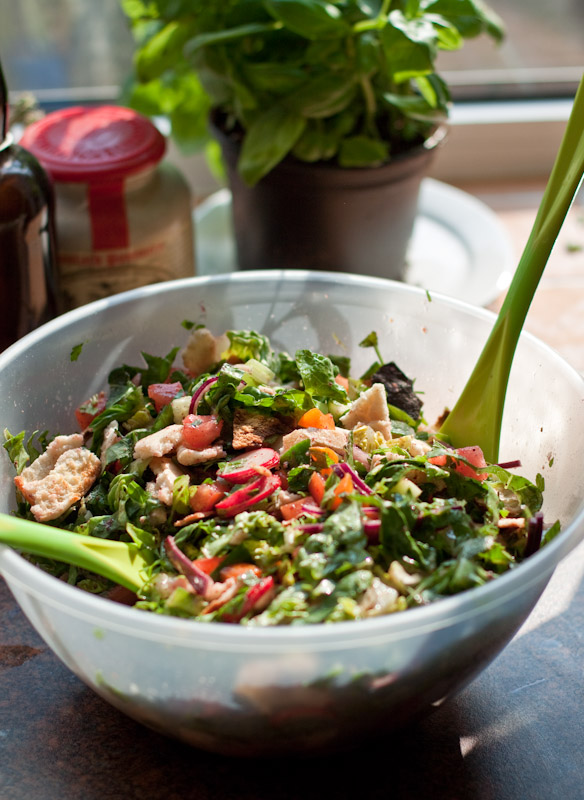
Stir it up…
Finished dish
Yesterday I found myself in a branch of Morrisons in search of their Ten Pound Pimms’ offer. Sadly Camberwell was very lacking in refreshing summer beverages, but managed to redeem itself with an abundance of delicious pork products. I resisted the temptation to stock up on pork dripping and bacon ends, but I did succumb to a splendid looking pork shank.
I’ve never seen one of these before, either to buy or on a gastro-pub menu, despite the ubiquitousness of the lamb shank, but the price made me look again. Just over £2 for a kilo or so of shank appealed to my currently lean finances (even if I’m probably going to hell for buying intensively reared meat.) The label suggested roasting it and even at the counter my mind wandered to making something wholesome and hearty with Puy lentils…
Back home, I turned my attention to my cookbooks for a little bit more information on cooking the shank, but found them all somewhat lacking. Google was next up and it also offered surprising little in the way of advice, especially as there seemed to be no distinction drawn between pork shank and ham shank. Having established that as mine was actually pork, so I didn’t need to soak it, I realised that most of the braising recipes required a slow cooker or a tonne of ingredients I didn’t have. I decided to go with what the label suggested and keep it simple!
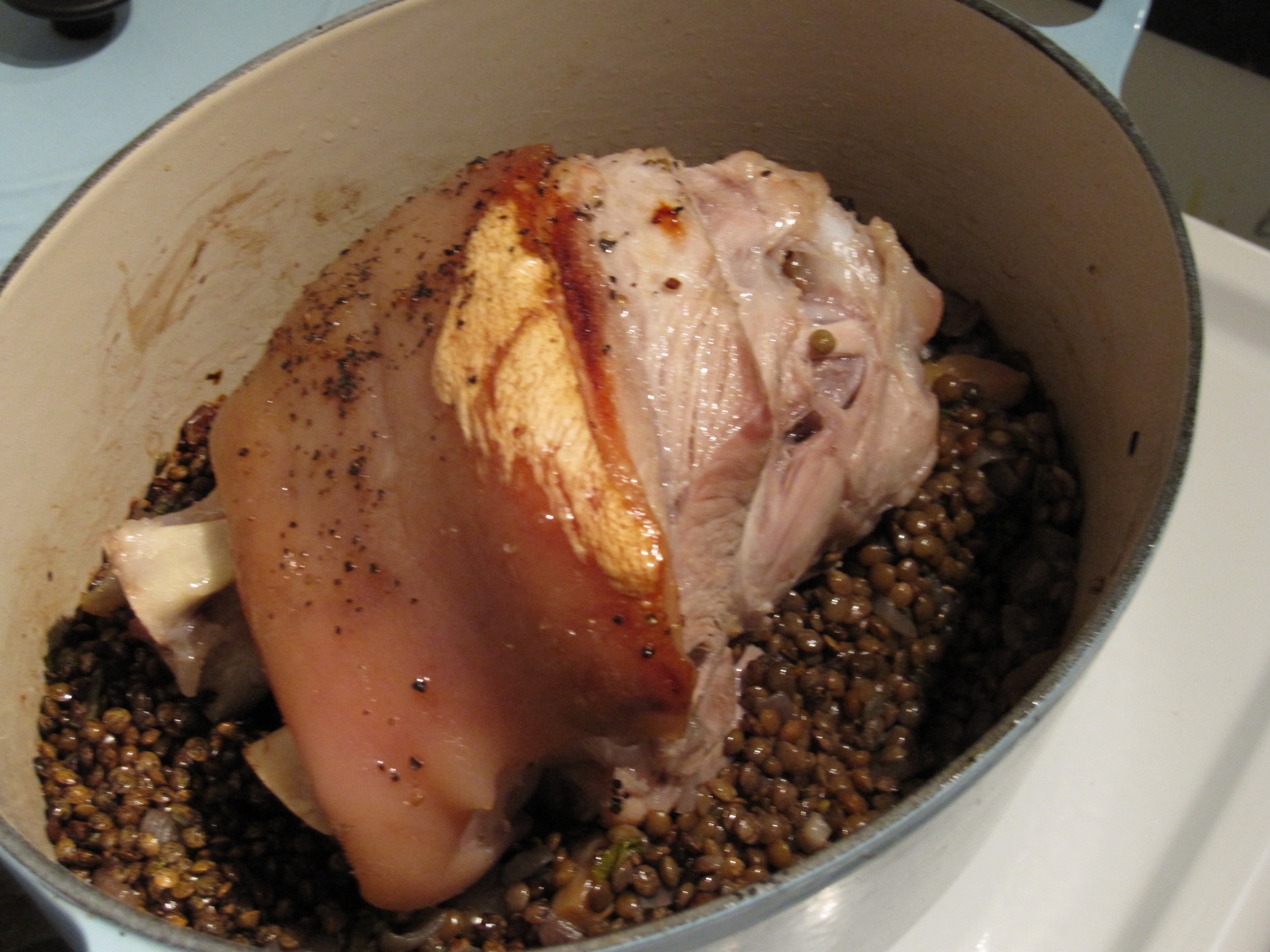
After leaving the shank out all afternoon to come to room temperature and dry the skin out, I seasoned it and sealed it in a casserole with a bit of olive oil until the skin started to colour nicely. Since I wasn’t planning on eating the skin, I didn’t attempt to get to crackling proportions. I then softened an onion and several whole cloves of garlic in the remaining oil, before adding some home grown sage and oregano and a few cupfuls of gorgeous glistening green Puy lentils. I added a good glug of homemade chicken stock, topping up with water until the lentils were well covered and plonked the pork back on top. Lid on, the whole thing went into a oven at 190˚.


Two and a half hours later, I opened the lid of the casserole to pork and legume heaven. The meat was soft and tender and easy to carve. But the lentils were the star of this show. Shot through sweet morsels of caramelised onion and hints of garlic and rich with pork juices and chicken stock, these were so good I could happily have climbed into the casserole and bathed in these beauties to get maximum enjoyment. Even if I had made twice the amount, I still wouldn’t have made enough of them…
As it was, I have enough lentils for 3 portions and enough pork for about the same, plus a bone to try making more stock or flavouring another dish, making this combo both delicious and economic. I’d like to try making it again with more ethically raised pork as it would make me feel less guilty and would probably be more tasty as well! I highly recommend picking up a pork shank if you happened to be in a Morrisons or a decent butcher. The knobbly wobbly bits of the animal often excel themselves and this cut is no exception!

Sometimes simple pleasures are the best. For me, this ticks all the boxes: great local cheese, great local ham, and not-quite-so local but equally great bread. The cheese was the remains of some of the original Calderdale Cheese which needed eating up, and I had a few small pieces of the air-dried ham left over, so I whipped up a bit of a rarebit-like mix. Miss South was visiting at the time I made this (this post is prompted by me finding these photos from early in the year), so I raided my stash of precious Veda bread from the freezer in celebration.
Veda, you say? Yes, these are slices of Veda bread (truly one of the high points of Northern Irish baking culture), and for the uninitiated, Veda is a dark, malty loaf. A bit like Soreen, but without the fruit, and not as dense a mix. It seems at one time Veda was widely available across the UK, but over time tastes have changed and the last remaining backwater of the country to keep Veda in a place close to their heart is Norn Irn. Several bakeries still produce it over there, but try as I might I’ve never managed to track it down on this side of the Irish Sea.
Miss South and I grew up eating (and loving) the humble Veda bread. One wouldn’t do much with it… possibly toast it, or add a few slices of mature Cheddar… the slightly sweet malty flavour, and almost sticky texture was enough. I’d often eat half a loaf of this diminutive loaf in one sitting: something encouraged by the fact Veda never comes sliced, so you tend to cut off big doorstep-like wodges to toast. I’m salivating at the very prospect, just writing this now… I’ll be filling a suitcase with Veda next time I go back to see family. Over the years I’ve converted more than a few folk to the exquisite delights of Veda… I would dearly love to proselytise further. Let me know if you fancy a slice of Veda toast some time!