Sprats, spuds and Swedish sauciness

Miss South and I have a long-running appreciation of the herring family: from whitebait, the essential anchovy (in all its multifarious forms) through to sprats, pilchards, sardines and herrings; little silvery fish get a full-on thumbs up.

Curiously I’d come late to the pleasures of sprats… but once I discovered how cheap (and I mean cheap) a handful of good fresh sprats could be, I was a convert. Normally I’d have them very simply; tossed in a dusting of flour and smoked paprika, grilled whole and finished with a little freshly-squeezed lemon juice, then eaten with some fresh crusty bread. The fact these small fish also answered to the delightfully silly scientific name of Sprattus Sprattus only enhanced their place high up the canon of favourite, fast, fishy fixes. But I alliterate too much…

So I was delighted when Miss South gifted me a tin of Swedish sprats as a Christmas stocking filler, which she’d picked up on her previously documented mission to the wonderful Scandanavian KitchenRead more

Pleasant pheasant…

It may have been noted by regular readers of the blog that Mister North and I do like a bit of game, but I have to admit to being rather challenged when he got a pheasant recently from Stansfields of Todmorden. Thanks to a childhood experience of a pheasant that had been too well hung and gone into a whole new realm of gameyness, I have been dubious about eating this beautiful bird for years, but the suggestion of using the tin of foie gras or libamáj that Mister North picked up in Hungary as a sauce with it convinced me otherwise!

Neither of us had ever eaten foie gras before and while I’m aware of how it is made and that a lot of people find it incredibly cruel, I have to say that I have always wanted to try it at least without getting into a huge debate about the stuff, so being able to test it out at home with someone with a similar mind set was ideal, because more than anything, I was worried it would be too rich and I wouldn’t like it…

Read more

Posh squash nosh…

The festive period is just the time for some serious indulgence, but you don’t need to do it all on Christmas and Boxing Day. New Year needs something to make it more alluring in my household and the idea of staying in with a bottle of fizz (or two) and some delicious mini munchkin squash fondue makes me want to stay up late…

Mister North and I cooked these to accompany a fantastic foie gras and pheasant feast the other week and they were so good, I’ll be making them again to indulge in as the clock strikes midnight. They are incredibly easy and would make a divine dish for any number of people with their individual feel. You could use any type of cheese for them, but we pushed the boat out and used a truffled brie from Hartley’s Crumbly Cheese stall in Todmorden Market…

Inspired by a recipe in Rachel Allen‘s Bake book and adapted by her from a Hugh Fearnley Whittingstall idea, I’ve made this my idea of heaven by using the mini Munchkin squash from my own garden and filling them up before blasting them in the oven and serving with little nibbles of sourdough bread. They are indulgent, moreish and super easy to make (even if you’ve already had quite a lot of fizz)  and make a lovely difference from the various sweet Christmas treats around.

You can use any round squash or pumpkin you happen to have, but I do love the greed factor in the individual ones. Chop the top off to make a good sized lid and then scoop out all the seeds, taking care not to poke any holes in your pumpkin. Brush the inside of it with a slight brushing of oil and add a teaspoon (more if using the larger squash) of cream and then fill up with your cheese of choice. I used the aforementioned truffled brie, but this would be brilliant for leftover Christmas stilton. Make sure it’s well filled, but not so stuffed it will bubble over in the oven and waste good cheese. Season well and place the oiled squash lid on firmly and pop in the oven at about 180 degrees and cook for about 15 minutes or until the squash is soft and golden and the cheese is bubbling.

Try and wait just long enough that you don’t burn your mouth so much you can’t belt out a chorus or two of Auld Lang Syne later and then start dipping into the soft sweetly infused cheese with bread, crackers, leftover roast veg or anything else you can think of. Just leave a tiny bit in the bottom to get the full effect when you scoop out the yielding and delicious squash onto you bread and devour joyously.

These little squash look adorable and would be a lovely thing to serve to lots of people if you have people round and fancy a doing dips and chips but need something warmer than a tortilla chip and some hummus. They’re easy to make and can be done well in advance, just needing popped in the oven when the time comes. In fact, do a selection of them and create your own fondue fabulous cheeseboard in front of the fire and then feel smug as you tuck in thinking of all those poor people in the taxi queue…

Sprout and about!

Brussel sprouts appear to be the festive equivalent of Marmite…terribly British, extremely versatile and loathed and loved in equal measure. For most people it just wouldn’t be Christmas dinner without them, but I’ve rarely met anyone who seems utterly devoted to their green goodness, but I have a recipe that might change all that! Adorn your plate with the incredibly easy and utterly heavenly roasted brussel sprout this year!

Tossed in hot oil or goose fat for a more indulgent feeling, these much maligned veg become green goddesses. A crisp outside yields to a tender inner, packed with flavour and filled with goodness. The intense heat really brings out their flavour with no danger of them being soggy or with that bitter brassica bite.

It’s almost insulting to post a recipe for you as these are simply the easiest thing around. Peel off the outer leaves, season well with just black pepper and toss in hot oil or fat and roast whole in the oven for around 30 minutes at 180° until crisp and delicious. Sprinkle well with sea salt and serve immediately.

You can make these even more delicious by adding bacon or chorizo or roasted chestnuts or my particular favourite, a sprinkling of crumbled blue cheese in the serving dish. Just be sure to make more than you think you need because even the most ambivalent sprout eater will want seconds of these little stunners!

Pot luck with Lancashire Hotpot

Autumn’s definitely the time to turn up the heat, run down the blinds, and take solace in slow-cooked, slow-release, one-pot wonders. As I felt the first fingers of frost tapping on the windows in October I decided it was definitely time to blow the dust off my slow-cooker, which doesn’t get much love during the summer months.

One morning when I was at Stansfield’s the butcher, I asked about the availability of mutton. As chance would have it, some was due in later that day: Paul had serendipitously thought it was about that time for the older, more flavoursome meat to make a reappearance as it was drawing in a bit out there. Now, I love a good bit of mutton. Snobs may turn their noses up at an auld bit of sheep over a young lamb, but for certain dishes I’m a firm believer that the grain and richness of an older beast is much more appropriate. The dish I had in mind was a good old Lancashire Hotpot, a perfect home for an older sheep to end its day in…

It’s hard to find a definitive recipe for Lancashire Hotpot: such a family favourite means there are a thousand variations and versions, particular to a certain place. I’ve had delicately-balanced miniature portions in restaurants and great splodges of home-served goodness, and the unifying elements are normally lamb/mutton, carrots and spuds. After that it seems to be open season for a whole range of additional elements.

A few years ago I saw the Hairy Bikers making hotpot in Bury Market and they suggested adding a layer of the local black budding to give a layer of unctuous goodness at the bottom of the pot.I tried this the first time I had a go at making this dish, and never looked back. Black pudding makes a great gravy base at the best of times (as used here) and it adds an extra touch of the local speciality to a hotpot.

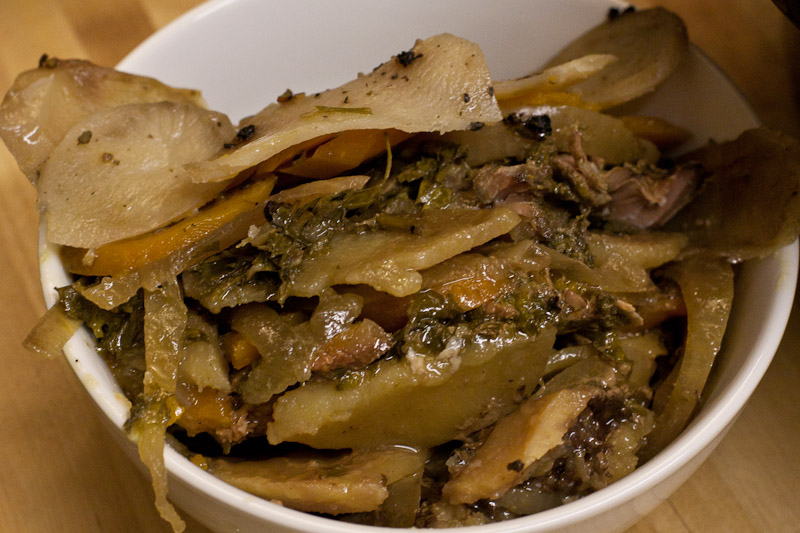
I started by slicing a load of spuds and carrots, then laying down a layer of thinly-sliced spuds on top of a well-greased pot. Season well, and add the next layer… in this case a sliced link of Ireland’s black pud. Then another layer of spuds (I love that dauphinoise-esque experience of lots of layers of well-buttered spuds) and pieces of mutton, cut fairly small and mixed with some fresh parsley. Then that was covered by sliced carrots, then potatoes, then mutton and… well, you get the picture. Hardly scientific in terms of quantities, but delightfully fun to arrange.

Last time I made this I added a proper stock, but reckoned in the slow cooker I’d be able to rely on the liquid in the veg, so just poured some water down the edges, mixed with Worcester sauce. Some older recipes suggest adding oysters to the mix: I added a splash or three of Anchovy Sauce for a similar umami kick. The whole thing was then finished off with slivers of butter on the top, before the lid went on for 8 hours of overnight slow-cooking.

Proper Lancashire friends have told me the origin of the dish is that was cooked slowly all day in oven, ready for the working folk to get home. I’m a fan of all things cooked for aeons so the slow-cooker (crockpot) seemed a likely option. What I’d not bet on was how appealing it is to wake up to the heavenly smell of a hotpot: It took an almost superhuman effort not to wolf down a portion for breakfast, and instead save it for my intended evening meal.

Fast forward through the day and I served this up to a friend for an informal evening meal. Always good to see us attacking the pot for seconds with such gusto: hopefully this proves the worth of such a classic, simple, traditional British dish. Preferably the slower cooked, the better!