
Gilak, or Persian Perfection!

This week saw my dear friend E’s birthday and to celebrate this event, she suggested dinner at Gilak on the Holloway Road. Named for the cuisine of a northern region of Iran, with its own distinct language and culture, this is a relative new neighbourhood restaurant close to home for her and she was keen to try it out for size. It ended up being such a great night out in general, it was hard to tell which one of us was having the birthday treat…

Situated very close to Archway tube, this low key restaurant is spacious and friendly. We had booked and checked that despite what Guy Dimond says in Time Out that they are still BYO. We were late for our booking and came clutching champagne but were welcomed calmly and politely and soon seated with a glass of fizz and the impressive menu.

Only one of our party had eaten there before and even if it meant sheer gluttony, we were determined to try as much of the menu as we could, so we each ordered a starter dish which could be shared. E espied the Persian gherkins and olives on the menu before even me, so I went for boorani-e-esenfenaj or steamed spinach in yoghurt dip instead. M went for the dairy free option of kale kebab which is a dip made from smoked aubergine, walnuts, sour pomegranate and garlic with flatbreads on the side. A reprised her previous order of the Gilak Special which is a meze style dish of boiled broad beans, walnuts and smoked fish, eaten with flatbread.

Gilak special

The champagne was starting to go to our hungry heads so we were delighted when the cold starters arrived promptly and were put in the middle of the table to share as wanted, although since I am generally unenamoured of both walnuts and smoked fish I avoided the Gilak Special, but everyone else seemed to enjoy it, especially with the slightly anise infused gherkins and lime soaked olives on the side.

The flatbreads were paper thin and so soft and chewy you could have eaten them on their own, but they were delicious dipped in the slightly sour spinach dip. However, used to scoop up the aubergine dip, they were transformed into something truly spectacular. This rich silky smoky dip could convert even the most ardent aubergine hater into a total obsessive. It was bursting with a multitude of flavours and texture that I could have eaten twice of much of as I did, even though I usually ambivalent aubergine and have made my feelings about walnuts clear. If I’d had more champagne at that point, I’d have blamed the bubbles and licked the plate clean…

Dip heaven…

Having thoroughly enjoyed our starters, we had a moment or two for breathing space, opened some more fizz and grew more excited as we saw plates of fluffy rice and amazing grilled meats go past. We were not disappointed when our turn came.
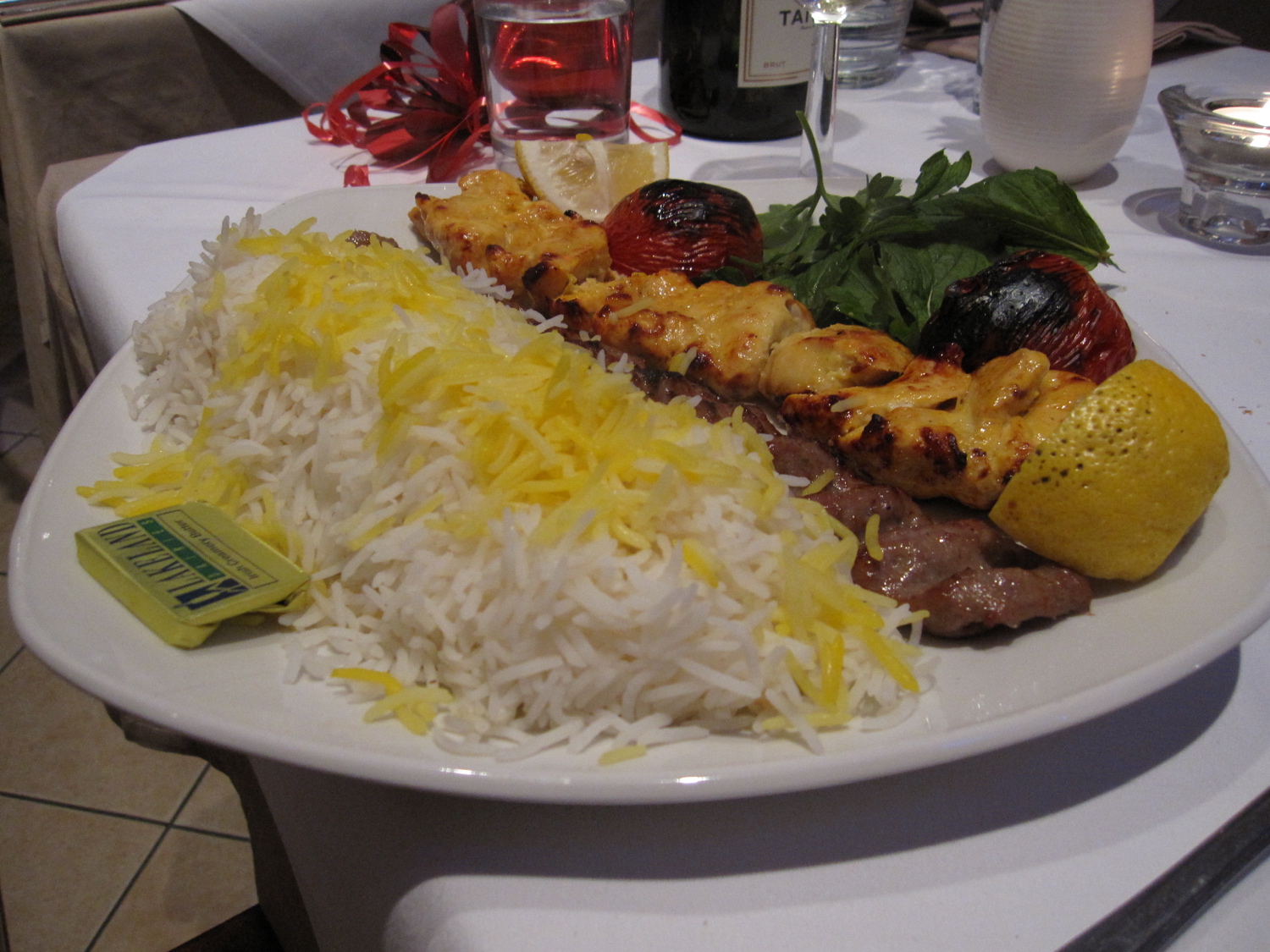
Kababs

E had gone for a traditional grilled meat kebab or chellow kabab momtaz of both chicken and lamb which wasn’t the most attractive looking dish, but was generously portioned and full of beautifully cooked meats packed full of flavour. M and I had also gone for meat based dishes, with M choosing khorest alou mo samma or chicken in tomato sauce with dried plums. This was deliciously deep flavoured with the sweetness of plums complimenting the umami-ness of the tomato beautifully. The bone in chicken was tender enough to serve with a fork and spoon and it seemed to go down very well, especially with the beautiful rice on the side to soak up the juices.

Chicken with dried plums

I had chosen a stewed lamb dish or koresht gheimah. This is cubed lamb in a tomato sauce with yellow split peas, dried limes and chips. I have to admit the mention of chips in this otherwise very grown up sounding dish is what made me choose it to see if it would be as weird as I thought! And I was not disappointed! A rich thick stew of pulses, lamb and whole dried limes, it came sprinkled with teeny tiny Mini Chip style chips that added a lovely satisfying crunch to each mouthful! Everything worked really well with the limes adding a pleasing pucker to the dish almost like a grown up sweet and sour. I loved it!

Chip-tastic!

A had gone for one of the meat free options on the menu with the mirza ghasemi which is an aubergine based stew with eggs and tomatoes. Not entirely vegetarian, it comes with smoked fish and pickled garlic on the side, but these would be easily avoided if you wanted to go flesh-free. A little bit like the aubergine starter, this wasn’t the most appealing looking dish, but it tasted truly amazing. Tomatoes being a fellow nightshade make natural bedfellows for aubergine and the eggs add the pleasing dairy-esque richness that makes moussaka so delicious, but without being as rich or overwhelming as that dish can be.

Aubergine delight!

Despite the hearty portions, we managed to clear our plates well thanks to the fresh feel of the dishes and good atmosphere. Enjoying ourselves immensely, E and I managed to find enough space to order a plate of zolbia bamyeh or Persian flour and egg rose water pastries drenched in syrup. The others went for a pot of Persian tea, infused with clove and cinnamon and very similar to chai. The pastries were nice, but the least exciting part of the meal since they were simply sweet and syrupy rather than particularly flavoured with rose water or saffron. I didn’t feel they added much, but didn’t regret ordering them either.

Sweet as syrup

Our entire bill, excluding tip, for this veritable feast came to just over £60 (I can’t remember and how many pence) and worked out at around £15 per head. Obviously this is a bit lower because the price of any alcohol isn’t included, but we all felt that for the quality and amount of food, it is an absolute bargain. The efficient and unobtrusive service deserved a good tip and we were pleased to see we could leave what we saw fit. This was generous as we felt very welcome and were well tended to.

Gilak seems to bill itself as a good neighbourhood restaurant, hoping to make people more aware of Persian cuisine, but I’d say it’s in fact just a great restaurant, well worth a visit. If you’re lucky enough to have it in your neighbourhood, then I have serious aubergine envy. I’ll be back here like a shot. I’ve even got my next meal planned out from the menu (even though it might involve two main courses!) With food like this available there, this south London girl will be Archway bound again as soon as possible!

Sweet on corn…

It’s still theoretically summer and that means just one thing to me right now….fresh corn on the cob! I can’t get enough of those sweet juicy bursting kernels of sheer goodness in the past few weeks. And with tightly wrapped ears of corn a mere £1 for four at the farmers’ market last week, I can afford to indulge this lust with wild abandon.

I’ve been eating the corn straight from the cobs, lightly boiled and slathered in chili and butter, dripping down my hands and smeared over my face as I eat the barely cooled corn over the sink with glee. I’ve stripped the kernels from the cobs with a knife and added these yellow nuggets of joy to the classic Chilean stew of porotos granados to put my munchkin squash to good use. And I’ve made stock with the denuded cobs and warmed up these increasing autumnal evenings with the delicious chicken and sweetcorn soup from the Leon Cookbook. And yet I still can’t enough corn so when I stumbled across a recipe for double corn muffins, I just had to make them…

A Dan Lepard recipe from the Guardian Weekend magazine, this is an incredibly simple recipe which combines fresh corn kernels, cornmeal and grated courgette, making it perfect for anyone with a zucchini glut! I decided to leave the bacon out as I wasn’t sure if I was serving these to any vegetarians and replaced it with a scotch bonnet pepper for a bit of a tingle. Other than that I followed the recipe exactly.

And it is a particularly easy recipe to follow. A quick softening of the onion, pepper and corn while I measured out the dry ingredients, beat an egg and poured the wet ingredients in my beloved measuring cups, then stirred it all together in one large mixing bowl. No folding, no faffing and absolutely no chance of over working the flour because it all combined beautifully. I mixed up this chunky flavoursome batter and popped it in the fridge overnight, so I could make the muffins fresh on Sunday to take to accompany a fried chicken fest at a friend’s house.

In the morning I spooned one dessertspoon of the batter into a regular sized bun case. Obviously these are meant to be muffins, but I’ve run out of muffin cases and couldn’t be bothered going in search of some over the Bank Holiday weekend. I planned to reduce the cooking time slightly to balance up the smaller sized muffins, but since I’m not at my sharpest early on a Sunday without at least two cups of tea in me, I actually put the oven on at 180° instead of 200° and ended up having to leave them in for 15 minutes longer after turning the oven up a bit to get them both cooked and appetisingly golden brown.

The mini muffins came out looking rich, glossy and golden but the paper cases looked soaked in oil even though I think I might have undermeasured it, but definitely had a bit less courgette in there that might have helped soak it up. I left them to cool slightly on the advice of the recipe to firm up before sampling the smallest and least appealing looking of them just to make sure I wasn’t going to poison anyone!

They were pleasingly firm, breaking apart cleanly and without disintegrating into crumbs. They were deliciously moist and studded with chewy kernels of corn with a good kick from the scotch bonnet and tasted so intense I could have sworn there was a bit of mature cheddar in there too. And despite the marked cases, they weren’t at all oily on the tongue, remaining light and chewy.

While these were a good accompaniment to chicken and would be a good breakfast dish too, they didn’t really make the most of the corn as it ended up tasting suspiciously like tinned sweetcorn after I’d cooked it. In fact with the scotch bonnet added, it tasted a bit like that weird tinned corn with bits of peppers in which was not what I was expecting. They would have been better with the sharpness of cayenne instead of the fruitiness of scotch bonnets or chilli sauce to minimise the tinned feeling. I might even go crazy next time and add some cheddar or parmesan to oomph up the umami undertones they already have.

But if you ever find yourself with a forlorn tin of sweetcorn, a courgette that’s seen better days and 30 minutes to spare, you couldn’t do better than making a batch of these, preferably full sized, and serving one split in half with a fried egg on top for a top class store cupboard supper…

Ravioli

I have had a hankering to make pasta from scratch for quite some time, but the precision of Marcella Hazan’s instructions have made me cautious. I remember my mum making fresh pasta as a child and it always seemed like a grown up version of Play Dough in its simplicity, but this seemed much more tricky and likely to go wrong, especially as I don’t have a pasta machine. Then I stumbled across a much simpler sounding recipe online which seems to have been adapted from this Jamie Oliver recipe and decided that I would take the plunge…

My friend G came for dinner on Friday and I decided to try the ravioli recipe since he would simply laugh if I messed it up and be happy enough to eat pasta out of a packet instead! Plus I could rope him into pouring extra flour or water into the dough if needed to save on getting my sticky paws everywhere!

And I’m glad I did have him on hand. As usual, the recipe called for large eggs when I only ever buy medium (a friend who keeps hens tells me the large ones are bad for the hen) so I immediately wasn’t sure if my proportions were right. I added an extra teaspoon of olive oil and the whole 55ml of water called for, but the dough seemed incredibly sticky, so G sifted in a tablespoon or so of extra flour and it seemed to come together very nicely. I then kneaded it for about 5 minutes and it was beautifully glossy and elastic at that point and very easy to work with the rolling pin.

I quartered the dough, learned from my mistake with the pretzels the other week and oiled the worktop before rolling the dough as thin as I could with my rolling pin. I then used a shot glass to cut circles from the dough, before rolling them again to make them thinner and easier to fill.

My choice of filling was some chard fresh from the garden, sauteed down with some anchovy and garlic, cooled slightly and chopped even finer before squeezing any excess liquid from it. I thought the iron rich tang of the chard would complement the pasta perfectly, like spinach on steroids. The leaves and stalks had a lovely texture and I put a teaspoon full of the mix onto each a pasta circle, brushed the other half with water and then pressed them together, before using the shot glass to cut the dough again to give a neat looking finish.

This is all very simple, but unsurprisingly since it was the first time I had ever worked with pasta, mind-numbingly time consuming. Making enough ravioli to cover a dinner plate, took me about an hour and used a quarter of the dough. G was almost ready to eat a tea towel by the time I started on the second quarter. I made about 2/3 of the same amount again before I ran out of chard and abandoned the pretence of making any more ravioli before one or other of us actually fainted with hunger.

The home grown tomatoes had been slowly roasting in the oven throughout my protracted pasta session and were perfectly cooked and ready to go so I got a large pan of boiling water going on the cooker and realised in my glee at making recognisable ravioli I had forgotten to oil the plate they were sitting on or even dredge the pasta with flour like the recipe instructed. So my lovely little ravioli were stuck fast and required some almost surgical attention with some warm water and a knife to prise them loose, meaning some of them looked a bit stretched and others had actually holes in places. I patched them up as best I could and cooked them for about 4 minutes til they came to the surface of the water.

Slightly battered, but beautiful!

I drained them in a sieve, put them back in the pan to dry out further on the heat, added a teaspoon of oil to prevent them sticking together and served them up with a splash of ruby red tomato sauce and some grated parmesan on top…and they were great!

The chard worked beautifully with the pasta, the tomatoes tasted like heaven and the pasta was soft and silky and even where it was a little bit thick at the edges in places, it wasn’t heavy or claggy on the tongue, just a reminder that when you think the dough is thin enough, roll it again! But despite this, we were both impressed by the pasta and ate every scrap in record time.

I’ll definitely been making fresh pasta using this recipe again, but making sure I roll, roll and roll again first. Hopefully with a bit of practise my ravioli won’t take all night in future. I was certainly a bit faster when I used the leftover dough to make a fantastic summer vegetable lasagne the next night! I might even manage to take some half decent photos too!

Summer pudding

Yes yes, I know summer is hiding her light under a bushel right now, but I’m hoping to coax her back by eating a variety of delightfully summery dishes all the while. And what is more gloriously summery (or more gloriously British) than a panopoly of soft fruits?

A recent trip to Brixton’s Farmers’ Market came up trumps when I came home with an old fashioned paper pick-you-own punnet with a handle filled with fresh juicy Kent cherries, gorgeous redcurrants and tiny tart whitecurrants all for £4. The cherries didn’t even make it til teatime, eaten one handed on the patio while reading the Sunday papers. The currants didn’t lend themselves just as well to absent-minded nibbling being much tarter and less juicy. I half-heartedly ate a few and went off to rummage in the freezer for something for dinner…

And while there I espied a forgotten bag of frozen summer fruits from Sainsbury’s and my mind leapt to making a juice drenched summer pudding as a beautiful vehicle for some organic thick cream I happened to have picked up as well. I’m a big fan of the frozen fruits Sainsbury’s sell, especially when on an offer for three bags for a fiver and often buy them to make my five a day more interesting and affordable. The fact that they also make a mean frozen daiquiri is entirely incidental!

I haven’t eaten summer pudding for years and wasn’t entirely sure how you make it, but figured it would be fairly easy once I found a recipe. A quick Google turned up this fantastically easy sounding one from Sophie Grigson on the BBC Food Website that sums up just how easy this fabulous dessert is to make! Especially since my local shop has an inability to sell fresh sliced bread, with all their loaves seeming a bit dry round the edges. This makes them perfect for a good summer pud!

Luckily I had lots of time to make the pudding so I was able to leave the frozen fruits to defrost overnight and brings the juices out as recommended, although I halved the amount of sugar she suggested. However I don’t think you’d be missing too much if you go straight to the heating stage. I simmered the fruit for about ten minutes, before adding a few tablespoons of Ribena and allowing it to cool enough to be able to dip my bread into without burning myself. I trimmed the bread of crusts while I waited and cut the slices into triangles, except for one that I cut into a circle using the base of the bowl as a template.

Once the fruit mixture had cooled enough, I dipped the circle of bread for the base in juice on both sides and began lining the bowl. I dipped each triangle on one side and began making my juicy jigsaw, wedging each piece of bread in carefully to make sure there were no gaps, adding little plugs of bread where needed. I then filled the bread shell up with the gorgeous fruit mixture and realised I was slightly short of bread to make the lid. Some judicious cutting and trimming later and all the fruit was covered and I was relieved that no one would see its hotchpotch look when the pudding was served!

I then put a saucer on top of it all, popped the bowl into the vegetable drawer of my fridge and put a few cans of chickpeas on top to weight it down overnight and allow the lovely juices to soak into the bread and help shape the pudding before eating. This should happen overnight, but it was a full 48 hours before I got back to mine. The juice hadn’t completely soaked through the lid and I was a bit worried that the pudding would fall apart when I turned it out. Crossing my fingers while I did it made it a bit trickier, but I needn’t have worried! It slipped out of the bowl easily and looked lusciously purple and mouth-watering on the plate.

I had a generous slice cut and on a plate with a dollop of thick cream in next to no time. It was delicious. The soft succulent bread contrasted with the still crunchy berries beautifully. The cream tempered the slight sourness of the berries and turned this frugal dessert into something truly stunning that I would servee to anyone. I’ve been eating this for breakfast most mornings this week and as well as tasting wonderful, it keeps incredibly well in the fridge. My five a day haven’t been this enjoyable in a long time!

Suffering fools gladly…

gooseberry_fool-01.jpg

I was recently chatting with Miss South about the relative dearth of gooseberries for sale; prompted in part by a recent episode of the Food Programme about berries. We both loved gooseberries straight from the garden at our granny’s… the slightly peculiar texture (a little hairy and seedy like pomegranates or tomatoes) and tangy flavour was unlike anything else, and distinctly seasonal. A highly evocative memory of childhood.

An occasional treat, and one which brings back deliciously happy memories, is that of gooseberry fool. Thick cream and fruit, served in glass dishes during halcyon summer weather conditions in the countryside. In my mind’s eye, heavenly. The fact I’ve not had this dessert for so many years has undoubted contributed to a little rose-tinted spectacle wearing on my part, but also led me to crave enjoying this unctuous creamy delight all the more.

So when I saw a couple of punnets in Tesco (I’ve been scouring the markets but haven’t seen any for sale anywhere else) I pounced on them. The particular variety was touted as being sweeter and more suited to desserts than normal, and they had a slight ruddy glow to their green translucency. I was all for following a straightforward recipe for fool, but skimming through the ever-dependable Leon Cookbook I noticed they suggested pairing gooseberries and elderflower, which sounded like a wonderful match. They also suggested mixing greek yoghurt with double cream to create the creamy base, which I thought would add a touch more tang and bite to the flavour. As with all good recipes, it provided a helping hand rather than a restrictive straightjacket… not least as I didn’t have all the ingredients to hand in the correct quantities.

First the fruit got cooked down in a mix of water and sugar (a bit less sugar than Leon had suggested as the variety of berry was supposed to be sweet) and then cooled down. A couple of tablespoons of elderflower cordial got added to the mix (my homemade elderflower liqueur is still brewing away although I’d like to try this again with that once it’s ready). I used roughly a 2-to-1 proportion of double cream to natural yoghurt, then whipped the mix until it got as close to that ever-smirkworthy state of ‘stiff peaks’. The fruit was then folded into the dairy mix, squashed and smashed but still ostensibly whole. This proved to be much better than creating a smooth compote, as it made for a contrasting texture sensation. After dividing into bowls and bunging them in the fridge overnight I was able to enjoy a decadent breakfast course… light, creamy, tart, sweet and so moreable. Yum!

I’ve always liked the British predilection for fools, flummeries, blancmanges, syllabubs and other traditional dairy desserts. These haven’t totally faded from public culinary consciousness, but receive far less attention than they should. I urge you to rediscover the delights of fruit fools as they’re so damn good, and wonderfully easy to make.