Homemade Buffalo Curd Cheese…

I’m going to confess something. You’ll either nod sagely at my bravery or recoil in horror and never speak to me again. I’m just not that into cheese…

That’s not to say I don’t ever eat it. I’m partial to a nice slice of Jarlsberg (the holes make it taste better). I keep Parmesan in the house to add some extra umami to everything. And I’ll eat cheese at other people’s houses, but I never think to buy it and I never crave it. It just doesn’t tickle my fancy the same way a nice salami does. So I’m as surprised as you are that I made my own cheese last night.

My eye was caught by Hugh Fearnley Whittingstall’s column in the Guardian the other week explaining that making certain types of cheese at home is a walk in the park. I imagine cheese to be a combination of dairy and witchcraft so this intrigued me. And then I happened to come across a bottle of rennet in Waitrose* the very next day and the spell was cast. I was going to make my own curd cheese!

It is ridiculously simple. You need some non-homogenised milk, some rennet, a pinch of salt and some muslin or ahem, cheesecloth and then you can get going with a few small pieces of attention to detail. You should be able to get non-homogenised milk at a Farmers’ Market but if you want to do raw or unpasteurised milk for whatever reason, then source yours through Duchy Originals at most major supermarkets or try some of the suggestions here. And while you’re at the supermarket, follow this excellent tip from the comments on the original article and pick up a pack of muslin squares from the baby aisle. Much larger than the trendy facecloths around, you’ll get about 5 for a fiver and can use them for cheese making or the forthcoming preserves season. Just iron before use to sterilise it.

I was using raw buffalo milk from Alham Wood Farms and I was surprised to see just how creamy it looked in colour and texture. Much more like the milk when I was a kid and most appetising looking. I heated it to 38° with the aid of a thermometer and then added the rennet. I think I used a touch too much, around a quarter of a teaspoon to a pint of milk, but a little bit extra splashed in so I suggest you measure carefully and not above the milk itself if your hand isn’t too steady. I stirred it in well and then left it for 15 minutes to separate into curds and whey while I got on with a batch of lemon curd.

And when I came back, it really was like magic. What had been thick creamy milk was now a slightly unappealing layer of watery liquid and something that did look quite cheese like already. I scooped the curds out with a slotted spoon into the muslin and tied onto the kitchen tap to drain and set for around three hours, dispensing with the whey completely. This is all you need to do. I won’t judge you though if like me you keep going in and staring at it as if hoping to catch a glimpse of the alchemy as it happens.

About three hours later, when I could wait no more, I unwrapped my little milky miracle. And it looked like real, honest to goodness cheese! Possibly a little bit firmer than it was meant to be due to the extra splash of rennet, it looked like cottage cheese with the firmness of mozzarella. I served it crumbled on some green lentils and homegrown tomatoes and it was stunning. Slightly bouncy, with a touch of saltiness while rich and creamy, it turned some placid pulses into something rather racy as it melted slightly and soaked up the juice from the tomatoes.

I couldn’t get over how delicious it was and how unlike the shop bought equivalent in flavour and depth. That’s probably the buffalo milk but I like to think it’s my natural cheesemaking skills. On an effort to taste ratio, it scores maximum points. I enjoyed it so much I had exactly the same dinner the next night as well and probably would have done so a third night had I not run out of cheese. Had I been able to get my hands on some more milk, I’d have made more and served it on my favourite black pepper infused crackers from Ryvita. I might even have remembered to photograph the meal instead of gorging myself. I think it’s safe to say I finally get the cheese obsession. I’ve come over the dark side of dairy…

*which happened to be vegetarian on closer inspection.

Veda Bread Ice Cream

July is a hot month back home in Belfast. Not especially due to the weather, but because of the slightly heightened feeling on the streets due to the Orange Order marches held in what is known as the Twelfth Fortnight. This was the traditional summer holiday for the shipyard workers in the city and a chance to hark back and remember Catholics and Protestants knocking the pan out of each other at the Battle of the Boyne in 1690. For those of us who don’t enjoy some light civil disobedience, it’s a good time to potter around at home doing all those things you’d sort of meant to do all year since you can’t really go out. Or ignore them completely and spend time watching box-sets and eating ice cream instead…

Feeling oddly left out here in London, I thought I would try and join in with a ice cream recipe with a taste of home. I’ve been wanting to make a traditional brown bread ice cream since I got my ice cream maker earlier this year, but the arrival of my mother on the week of the Twelfth with every Northern Irish exile’s request in the shape of a loaf of Veda bread, meant I decided to give it an Ulster twist and use Veda instead.

A dark delicious slightly sticky (non-fruited) malt bread, Veda makes the best toast in the world, marrying together with butter like nobody’s business. Adding sugar to bring out the natural sweetness and crisping it up with butter is what my life has been missing up until now. Using this recipe by David Lebovitz, I crumbled the Veda into smallish pieces, fried off in butter and a good unrefined caster sugar and then toasted in the oven for about 30 minutes or until I had clusters of crispy, sticky, malty heaven that were so good, I could have skipped the ice cream and just eaten them alone.

But since I had promised ice cream, I made ice cream. The recipe uses a basic custard, but with the addition of cream cheese to stop it all being just too sweet. This is much more faffy, needing a third bowl, more counter space, a sieve, a whisk and more potential for the custard to curdle as it needs to be hotter to melt the cream cheese, so in future, I don’t think I’ll bother with this addition. Otherwise, it was all pretty straightforward.

I gave this ice cream a bit of a Brixton twist and added a slug of dark rum, some vanilla and then stirred the caramalised crisped up Veda into the churned mixture about five minutes before the end. Because the Veda is stickier and maltier than regular brown bread, the crumbs clumped up more and made huge nuggets of crispiness. Fearing that I would either break my teeth or the machine, I blitzed them in the blender to make them more crumb like. Everything then went in the freezer for a couple of hours to firm up and create hands down the finest ice cream ever created.

Creamy beyond belief but crunchy and chewy due to the crisped up bread crumbs and with a slightly grown up flavour from the rum, this was just magnificient. Rich with butter and with a gorgeous toffee feel, I defy you not to fall in love with this amazing ice cream and want to sneak a spoonful everytime you pass the freezer. It was declared even better than the Northern Irish ice cream institution that is Maud’s Pooh Bear Delight*.

You need to make this ice cream immediately. If you don’t have access to Norn Iron’s best kept secret, try it with some Soreen or a really good brown bread instead. This is what breadcrumbs aspire to being…

*Youse know it’d be belter in a poke.

Wham Bam, Thank you Razor Clam…

Mister North and I took a family holiday to Barcelona with our mum a few years ago to celebrate my thirtieth birthday and despite having a wobble about my new decade, I managed to mark the day in style with copious amounts of cava and some stunning food. The discovery of the weekend were razor clams at lunch at La Boqueria. Looking like old fashioned cutthroat razors, the only danger we were in from these handsome molluscs was overeating! Steamed until tender, they are soft, juicy and utterly delicious with chorizo. I lost count of how many times we ordered them, so imagine my glee when I found a bundle of these beauties in Brixton Market this week…
Read more

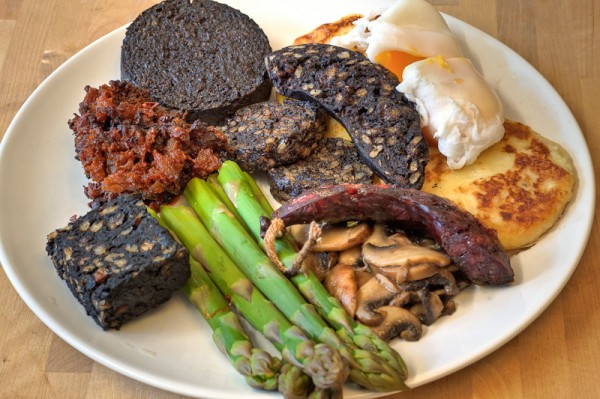
Bloodlust: six black puddings and a beer for breakfast…

Ever since some bright spark had the idea to stuff intestines with coagulated animal blood, flavourings and other assorted filler ingredients, humans have been making the most of their livestock’s leftover bits, enjoying the results greatly. As a result almost every culture has some kind of black pudding tradition. Miss South and I have been enjoying black pudding in various forms for some time, and as our appreciation and fascination with blood sausage has grown, we’ve idly contemplated a sanguine side-by-side comparison of various favourites. So we finally did it, pitting six of the best we could track down next to each other. But before you read about that, I should make a confession.

I didn’t like black pudding as a kid. Not at all. Miss South and I had it once at the house of a family friend (both it and white pudding, another traditional Irish favourite) and it put me off for a long time. To be honest, I don’t think it was the taste or texture as much as the knowledge at the back of my mind of what it was made from. I wasn’t especially squeamish but it was just too ‘bloody offal’ to contemplate, nevermind enjoy eating. Besides, it wasn’t a family favourite so we had little exposure to black pudding: indeed our mum thinks our modern love of the black pudding is very very wrong, and she’s rarely judgemental about food. So I start this post knowing black pudding can be divisive and disgusting for many folk.
Read more

A taste of home?

The Christmas I discovered duck…

I have read a lot in the past few months about culinary heritage, from articles about the attempts to save English apples to the eternal debate about food and class and discussions of regionalism in British food. I find this fascinating, but also wonder how much a lot of people can relate to this wider food heritage? Is it not the case that most people’s relationship with food is much more influenced by their immediate surroundings with the wider social aspects playing a less obvious role?

I grew up in a house engaged in food. My parents cooked almost everything from scratch, partly because that’s what they grew up on and partly because it was much cheaper and in 1980s Belfast where we didn’t didn’t have any national supermarket chains or McDonalds, it was pretty much the norm. My parents did have a slightly crunchy streak, making their own yoghurt and whipping up vats of dahl, but mainly we ate a mixture of traditional British and Irish dishes and slightly unusually for the time, real pasta (not the tinned stuff), rice and other meals influenced by my parents’ interest in travel. We ate well, but weren’t strangers to a fry or chips. Fussiness was not tolerated, although I was allowed to indulge in a teenage dalliance with vegetarianism. I spent a lot of time in kitchens as a child, watching people cook, both at home and at my granny’s farmhouse where a Esse cooker provided constant warmth and a never ending stream of excellent baked goods. Yet until I was nineteen, I couldn’t cook. In fact I could barely make toast and I couldn’t care less.

I had rebelled in my late teens, craving lurid foods from packets and cereals so sweet just looking at the box caused dental erosion. I was just about to leave home and unashamedly I was feeding myself a diet that a five year old would baulk at. Something needed to happen to stop me leaving my entire food heritage behind and hailing Pot Noodles as haute cuisine. And it did. It was an odd salvation, but one that would shepherd me back toward the path my parents had put me on. I discovered Ainsley Harriott.

Laid low by serious ill health, I watched a lot of daytime TV and the jewel in the crown of afternoon scheduling in the late 90s was Ready Steady Cook. It almost always featured Britain’s most exuberant cook and slowly and awakened an interest in cooking. I learned more about the technical side of making food than any Home Economics class had shown me and slowly but surely, it piqued my interest and I moved from sofa to kitchen. I’d like to tell you Ainsley’s easy inexpensive dishes were the motivation, but I think it was just as much as an urge to get away from his endless bellowing. I began cooking simple things, mainly pasta and couscous based, while I gained confidence in prepping ingredients and understanding timings. I’m sure there were some gastronomic horrors that my poor mother ate to be supportive, but I’ve blocked those memories out.

By the time I went to university, clutching the first ever cookbook I bought, a copy of Nigella’s How to Eat, I was pretty confident in the kitchen and unlike my flatmates who relied heavily on processed meals and parcels from home, I cooked everything from scratch, including making my own yeast free bread. Broke, bored and marooned on an out of town campus at night, I re-lived a childhood cooking interest and made apple crumble almost nightly for something to do, resulting in block wide ‘crumble offs’ and custard making competitions. Moving to London and starting a job in fashion stunted my fledgling interest in food slightly, living off Ryvita and cream cheese most of the time, but when money and parties were thin on the ground, happy to partake of ‘Goulash Night’ and slightly obsessive onion ring making with my housemates. I did also construct a (now sadly lost and much missed) recipe book of Vogue recipes, food article cuttings and Lindsey Bareham‘s brilliant after work recipes from the Evening Standard.

But it wasn’t til I moved into my current flat about five years ago that I really started to challenge myself culinararily. Living on a very restricted budget led me away from the trendier world of the celebrity cooks to a certain extent and back toward the skills and loves my parents instilled in me from an early age. I still rarely buy anything ready made (unless I can’t do it myself) and I am a demon with leftovers. Somewhere my granny’s love of baking has come back to me and I still whip everything up in her mixing bowl. The confidence and independence these skills offer me is worth its weight in gold (and the money it saves me) and I find it hard to believe that I didn’t pay more attention when I was younger, although thank god, I’ve got my mum’s potato salad recipe to hand!

I’m still very much developing as a cook. I’m a little bit nervous of doughs, pastries, batters and things involving yeast. My childhood love of oddly bland things such as Marie biscuits has never left me and despite being a food lover, I could happily eat plain brown rice, Ryvita and porridge five times a week. I’m not very cheffy in my presentation and Mister North is much more adventurous with his techniques and ingredients. My favourite childhood comfort food dish is still mince and potatoes, preferably cooked by my mum. But I’m enjoying following a path that my childhood set me on where I’ll try just about anything once, even if it also involves rather a lot of baking fails along with a revived love of lentils.

What about you? Who shaped your foodie path? Have you bucked childhood trends and tastes? Do the people around you influence your food feelings or do the TV chefs have more sway these days? Are bloggers your new inspiration? And have you ever successfully re-created those things other people cooked for to show you their love?