Comfort and Spice

Even if you aren’t a food blogger, you’ve probably stumbled across Niamh Shields’ fantastic blog Eat Like a Girl with its mix of travel, food, great writing and strong personality. It appeals to everyone from die hard foodies to people idly pondering what to make for the one Sunday lunch they do each year. I’m especially fond of it due to the fact Niamh proudly references her Irish roots, never apologising for the cuisine of my youth and helps sate occasional pangs of homesickness.

So I’d been counting down the days till Niamh’s first cookbook Comfort and Spice was published. I had pre-ordered it on Amazon and then Quadrille very kindly offered us a review copy to see what other Irish folk thought. Even on the first flick through I knew I’d have been happy to pay full price for it. I can’t remember the last time a cookbook excited me so much.

It’s quite a small book compared to some of the stupidly large tomes we’re used to these days, but there isn’t a single filler recipe in it. Split into sections such as ‘Hearty Lunch’, ‘Simple Suppers’ and ‘Eight Great Big Dinners’ this is a book written by someone who loves food but understands the home cook and their concerns and costs. There’s no cutting corners on quality and an encouragement to make things from scratch with dishes running consecutively so you can shop wisely while leftovers are given their rightful place. There is no assumption that you have unlikely kitchen gadgets or an army of kitchen staff to wash up items that didn’t really need used.

And if that isn’t already a refreshing change that sells the book to you, wait til you see the recipes. Based round a combination of clever shopping and a good storecupboard, I was cooking from it within an hour of it arriving. Cauliflower soup with spiced butter tortelloni lifted this humble brassica into an evening event so good I forgot to photograph it.

Black pudding croquettes perked up some mediocre slices from the supermarket along with a rosti and some homegrown tomatoes. Ricotta pancakes made Monday morning a sheer joy. The soda farls tasted as good as the ones off my Auntie Georgie’s griddle. Ham salt makes the world a better place and I can barely wait til Christmas to do the spiced beef.

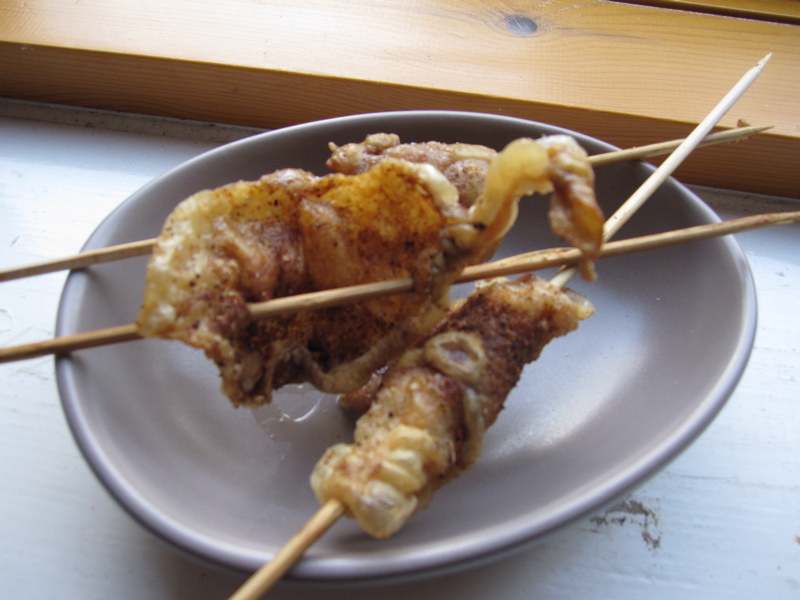
I have more recipes marked to try than not. I love the everyday luxury of the book with cook’s perks such as chicken skin skewers while the tasty practicality of two and six hour pork belly makes me want to invite the world to lunch. I can’t wait to feel the achievement of homemade butter and ricotta. It’s a book that speaks to all levels of cook from the novice to the expert and neither assumes confidence (or a vast spice cupboard of unheard items) nor patronises.

I just can’t think of anything I don’t like about it although if I was quibbling, I’d prefer a hardcover as my cover had greedy greasy fingerprints on it after the first goes. Beautifully written, brilliantly planned, I can’t fault it. Buy one immediately, bring the joys of chorizo on sticks into your life and let Niamh suggest all your meals for the next few weeks. You couldn’t be in better company!

Cassoulet: rabbit & pork to quicken the pulse(s)

We’ve written before on more than one occasion of our shared love for all things pulse and porcine. Pretty much every pork-eating culture in the world has at least one melt-in-the mouth classic which taps into both of these elements, exploiting the extraordinary harmony and symbiosis of flavour and texture which comes from such comfort food. These are truly made for each other, and it’s a massive favourite here with us at North/South Food.

Inspired in part by a great holiday to Languedoc (and armed with a few goodies on my return) I decided to make a semi-proper cassoulet as a way of warding off the rather autumnal weather which has blighted the north of England since coming home. Not a proper proper cassoulet (with all the regional rivalries that seems to stoke up) but my own interpretation. After all, it’s a genuine classic, and something I’ve never cooked before, so it was well worth having a go at…

I used my well-thumbed copy of Elisabeth Luard’s ‘Classic French Cooking as reference: her recipe for ‘Cassoulet de Castelnaudary’ seems pretty authentic. I deviated on a few occasions, perhaps most heretically by using rabbit rather than duck or goose. You see, I’ve had a bunny in the freezer for a few months, and coming home with a lovely artisanal French sausage, I thought something casserole-y would make for a perfect combination. After a bit of reading I warmed to the idea of cassoulet.

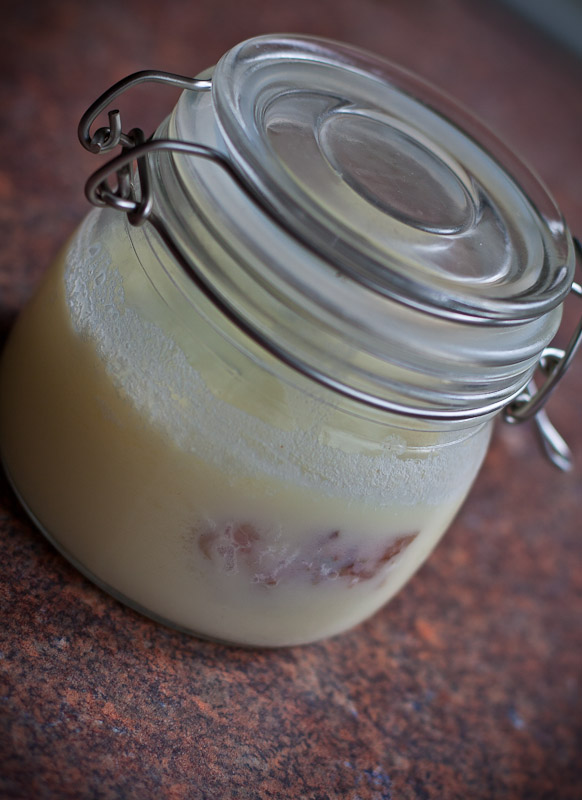
First things first, I had to make the rabbit confit. After a good defrosting I jointed the bunny… legs off and the body / saddle in three. I had some goosefat lurking in the fridge in a kilner jar (really not sure how long it was since I last cooked a goose but I decided to take the risk) and I had a tin of store-bought stuff as well. Tip: buy reduced-price tins of goose fat from supermarkets in the weeks after Christmas. It lasts for ever, and I’m sure you know just how good roast potatoes & Yorkshire puddings are, made with real goose fat.

I melted the fat down in a saucepan, then poured them over the layered rabbit joints in a stoneware pot. I’d also sprinkled salt over the meat (using wonderful fleur de sel from the Camargue), chucked a few peppercorns into the pot, and added a couple of bay leaves. Once the meat was covered by the warm, clear goose fat, it went straight into a pre-heated gas oven at the lowest setting, covered by tinfoil, and I left it overnight.

Next day a delicate aroma greeted me when I opened the kitchen door: inside the oven the meat had blanched and warmed through. very pretty looking too. I took out the legs, ate one of the other bits for breakfast on toast (chef’s perk!) and put the rest in a kilner jar, carefully covering with the fat. That was the rabbit sorted, now for the rest.

A quick trip to Stansfield’s in the market secured some belly pork (I got Paul to remove the skin for me) and some lean escalopes. I decide not to buy some fresh sausages, determined to subvert tradition and use the dried Aveyronnais saucisse instead. This is almost as heretical as using rabbit, but I thought the rich, fatty dry sausage would work well in such a slow-cooked dish.

So I diced the belly meat, and added it to the bottom of a cast iron Le Creuset (heretical decision #3… it should of course be cooked in stoneware but I didn’t have anything large enough). I opted for canned haricot beans over dried (life’s too short for soaking pulses) and added three tins of these, together with a couple of roughly chopped carrots, a bouquet garni, a red onion studded with cloves, and a head of garlic which I’d blackened quickly over a gas flame on the hob. Also in the pot went the rolled-up belly skin. Everything was covered with water, and raised to a rolling boil, before simmering for an hour or so.

After that was done I drained everything, reserving the cooking liquor carefully. I browned the rabbit joints in a heavy frying pan, then did the same with the lean pork and a couple of diced red onions & some garlic, letting them shimmer and glisten in the hot goose fat. I unfurled the pork skin on the bottom of the cast iron pot, and layered up the beans, veg and meats on top. A tin of plum tomatoes was ably accompanied by some home-grown toms, which looked as pretty as they tasted. As the ingredients stacked up I was worried by a deficit of beans to cover everything, so I added a extra tin of cannellini beans. Then I poured the cooking broth from earlier in until everything was just coated, lidded up and put it in the oven at gas mark 2 (150°C) for about two hours.

It was about then I realised that such a long cooking process was going to severely test my patience: the smell when I opened the oven was enough to make me want to gnaw my own arm off. However the next stages would mean it was some time before I could exepct to finally tuck in. After notching the oven up to 160°C the pot went back in, uncovered, to help develop a crust. This took closer to an hour as a fair amount more liquid had been drawn out of the tomatoes, but eventually there was enough of a crust for the next stage. I spooned some goose fat over the top, and broke the crust several times before adding a layer of breadcrumbs. Breaking the crust seems to be one of the defining differences between Castelnaudary and other towns in Languedoc which lay claim to cassoulet as their own. I opted to break the ‘croute’ seven times, as Larousse Gastronomique suggests this is the Castelnaudary way. Then back in the oven again to thicken up and cook for another half an hour or so. Cue more groaning stomachs – it was at this stage I cracked open some rather good anchovy-enfused Camargue olives.

We enjoyed this with a bottle of excellent Saint-Chinian red (sticking to the Languedoc theme) and some crusty white bread to soak up the juices. Dead simple, and all that was needed to really savour this dish. It tasted wonderful, and was well worth the anticipation and wait. Better still, as so many one pot meals do, it just got better over the next couple of days.

I’d give this 7/10 for adherence to tradition, but 10/10 for flavour. The sausage was excellent, adding a complexity and richness to the dish, and the rabbit was succulent and delicious. Sometimes traditions are there to be subverted! If this heralds the season to eat rich, slow-cooked one pot wonders, then I’m glad to wrap up warmer and take things slowly. Meanwhile I’ll be rationing out the goose fat from the confit for future cooking exploits… it’s a wonderful by-product of this dish. What’s good for the goose is certainly good for me…

Rosemary and anchovy flatbread

Going flat-out for flatbread …

Rosemary and anchovy flatbread

We’re both fans of fast, healthy and delicious Mediterranean-influenced food here at North/South Food. Miss South is definitely more confident and experienced when it comes to baking than I am, but a recent recipe I came across persuaded me to pander to my basest kneads and enjoy my daily bread.

I’m currently designing a cookbook for the wonderful Parlour Café on West Port in Dundee, run by Gillian Veal. Over the last few years her delicious and unfussy cooking styles have added some sunshine to the local food scene, and her recipes have become firm favourites with many Dundonians. So it’s perhaps only natural that Gillian’s sharing some of her favourites recipes with the wider world.*

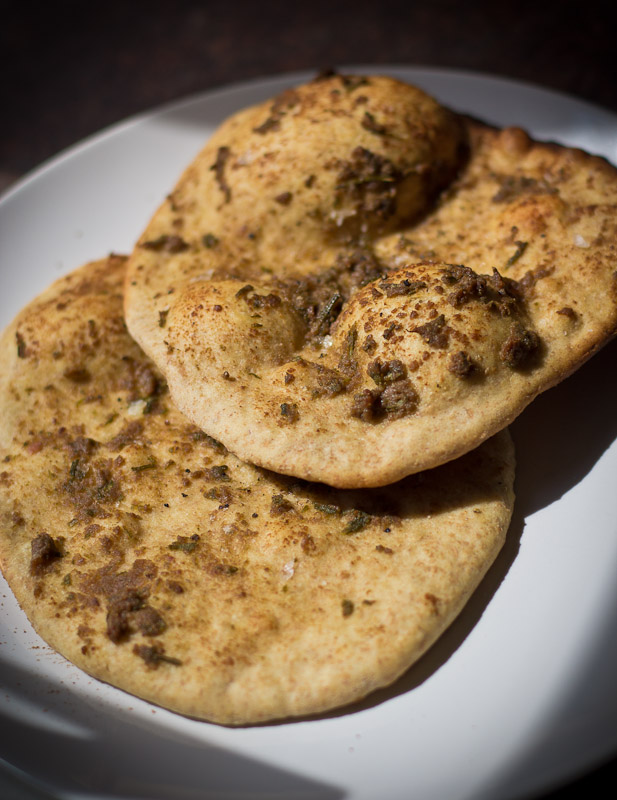
One of the pleasures (or should that be perils) of receiving the manuscript for a cookbook is trying to resist the urge to try out all the recipes: in this case as soon as I saw the recipe for rosemary and anchovy flatbread I was powerless to resist the temptation to snip sprigs of rosemary and crack open a tin of anchovies. Rosemary oil and salty fish on warm bread? Instant win!

Having made these a couple of times now I’m a major fan. Incidentally they’re so moreable I challenge you to make them last more than one sitting. Perfect with some home-made smoky hummus or an edamame bean dip.

So without further ado let me share this recipe, in Gillian’s own words, alongside my photos. Enjoy!

Gillian’s Rosemary and Anchovy Flat-Bread
Makes 8 – 10 flat-breads

● 250 grams wholemeal flour
● 250 grams of plain white flour
● 250 ml warm water
● 1⁄2 a teaspoon of dried yeast
● 80mls olive oil
● 12 anchovy fillets
● 1 sprig of rosemary ● sea salt and pepper to season

“Mix both flours in a large bowl and make a well in the middle. Dissolve the yeast in the warm water and gradually pour into the flour while mixing with the other hand. Pour in 60ml of the olive oil as well, and keep mixing until the ball of dough comes together. Turn the dough onto a lightly floured surface and knead until it becomes smooth and elastic – you will feel the dough changing and it will bounce back when you stick a finger into it (5 minutes should do it). Cover the bowl with cling-film and set aside somewhere warm for about one and a half hours.

Meanwhile prepare the topping. Tear the leaves off the sprig of rosemary, chop them roughly and bash them up in a mortar and pestle with the anchovies and a glug or two of olive oil until you have a rough paste.

When the dough has about doubled in size, punch it down, gather into a ball and divide into 8 – 10 pieces depending on how many people you’re feeding and how big you want your breads to be. Heat up the oven to 220C, and put in two lightly floured baking trays. Roll the dough pieces out into rough circles, about half a centimetre thick, and evenly spread with the anchovy and rosemary paste. Push it into the dough with your fingers and make sure they’re well covered.

Get the hot baking trays out of the oven, and place the waiting flat breads on them. Sprinkle with sea salt, freshly ground black pepper and a drizzle of olive oil and put back in the oven for around 6 minutes until they are golden and starting to puff up”


*If, as I suspect, this recipe whets your appetite then I urge you to buy the book when it’s published later this autumn by Kitchen Press. Wonderful recipes and delightful illustrations make this a perfect kitchen companion. We’ll have full details on here closer to the time…
Homemade Buffalo Curd Cheese…

I’m going to confess something. You’ll either nod sagely at my bravery or recoil in horror and never speak to me again. I’m just not that into cheese…

That’s not to say I don’t ever eat it. I’m partial to a nice slice of Jarlsberg (the holes make it taste better). I keep Parmesan in the house to add some extra umami to everything. And I’ll eat cheese at other people’s houses, but I never think to buy it and I never crave it. It just doesn’t tickle my fancy the same way a nice salami does. So I’m as surprised as you are that I made my own cheese last night.

My eye was caught by Hugh Fearnley Whittingstall’s column in the Guardian the other week explaining that making certain types of cheese at home is a walk in the park. I imagine cheese to be a combination of dairy and witchcraft so this intrigued me. And then I happened to come across a bottle of rennet in Waitrose* the very next day and the spell was cast. I was going to make my own curd cheese!

It is ridiculously simple. You need some non-homogenised milk, some rennet, a pinch of salt and some muslin or ahem, cheesecloth and then you can get going with a few small pieces of attention to detail. You should be able to get non-homogenised milk at a Farmers’ Market but if you want to do raw or unpasteurised milk for whatever reason, then source yours through Duchy Originals at most major supermarkets or try some of the suggestions here. And while you’re at the supermarket, follow this excellent tip from the comments on the original article and pick up a pack of muslin squares from the baby aisle. Much larger than the trendy facecloths around, you’ll get about 5 for a fiver and can use them for cheese making or the forthcoming preserves season. Just iron before use to sterilise it.

I was using raw buffalo milk from Alham Wood Farms and I was surprised to see just how creamy it looked in colour and texture. Much more like the milk when I was a kid and most appetising looking. I heated it to 38° with the aid of a thermometer and then added the rennet. I think I used a touch too much, around a quarter of a teaspoon to a pint of milk, but a little bit extra splashed in so I suggest you measure carefully and not above the milk itself if your hand isn’t too steady. I stirred it in well and then left it for 15 minutes to separate into curds and whey while I got on with a batch of lemon curd.

And when I came back, it really was like magic. What had been thick creamy milk was now a slightly unappealing layer of watery liquid and something that did look quite cheese like already. I scooped the curds out with a slotted spoon into the muslin and tied onto the kitchen tap to drain and set for around three hours, dispensing with the whey completely. This is all you need to do. I won’t judge you though if like me you keep going in and staring at it as if hoping to catch a glimpse of the alchemy as it happens.

About three hours later, when I could wait no more, I unwrapped my little milky miracle. And it looked like real, honest to goodness cheese! Possibly a little bit firmer than it was meant to be due to the extra splash of rennet, it looked like cottage cheese with the firmness of mozzarella. I served it crumbled on some green lentils and homegrown tomatoes and it was stunning. Slightly bouncy, with a touch of saltiness while rich and creamy, it turned some placid pulses into something rather racy as it melted slightly and soaked up the juice from the tomatoes.

I couldn’t get over how delicious it was and how unlike the shop bought equivalent in flavour and depth. That’s probably the buffalo milk but I like to think it’s my natural cheesemaking skills. On an effort to taste ratio, it scores maximum points. I enjoyed it so much I had exactly the same dinner the next night as well and probably would have done so a third night had I not run out of cheese. Had I been able to get my hands on some more milk, I’d have made more and served it on my favourite black pepper infused crackers from Ryvita. I might even have remembered to photograph the meal instead of gorging myself. I think it’s safe to say I finally get the cheese obsession. I’ve come over the dark side of dairy…

*which happened to be vegetarian on closer inspection.

Meatball stuffed tomatoes

There are somethings I never tire of and could eat for all eternity and one of those things is meatballs. I just adore them. Served with spaghetti, stuffed into a sandwich, as a canapé or just on their own, I can’t get enough of them. I usually use Allegra McEvedy’s failsafe recipe from the first Leon cookbook, but as the sun slowly came out over London a few weeks ago, I fancied something lighter and more summery. A chance encounter with some veal mince at Waitrose helped focus the mind and the next thing I knew, I had a plateful of veal, black olive and parmesan meatballs chilling in the fridge.

Pan-fried until well sealed and then steamed with stock until fully cooked through, I served them with some grilled courgettes and the pan juices for a treat of a Friday night dinner after a long week. And they were good. The sweet meatiness of the veal was enhanced utterly by the umaminess of the parmesan and the olives. I scraped the plate clean in record time and even recommended the combo to the little loaf on Twitter. But something was missing. It needed something to take it from good to amazing.

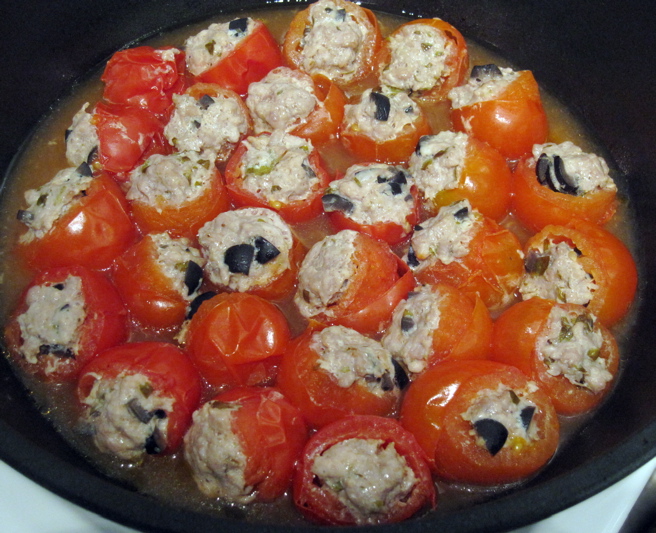
It had to be tomatoes. The July sun and heavy rains of the past few months mean that everything is better with a British tomato right now. Bursting with flavour and warmed up naturally by the flickering sun, they add a note to every dish that lifts it beyond just good. But even having decided on the welcome addition of tomatoes, it still needed something beyond just a sauce. And flicking through some stored up summer recipes, I saw an idea for stuffed beef tomatoes and it all fell into place. Meatball stuffed cherry tomatoes…

As I’ve mentioned before, my life is never too short to stuff anything. Not when everything is more delicious filled with something else. Taking the tops off and scooping out the middles of the cherry tomatoes is in fact no more time consuming than rolling individual meatballs and chilling them into shape. It’s almost as relaxing in fact.

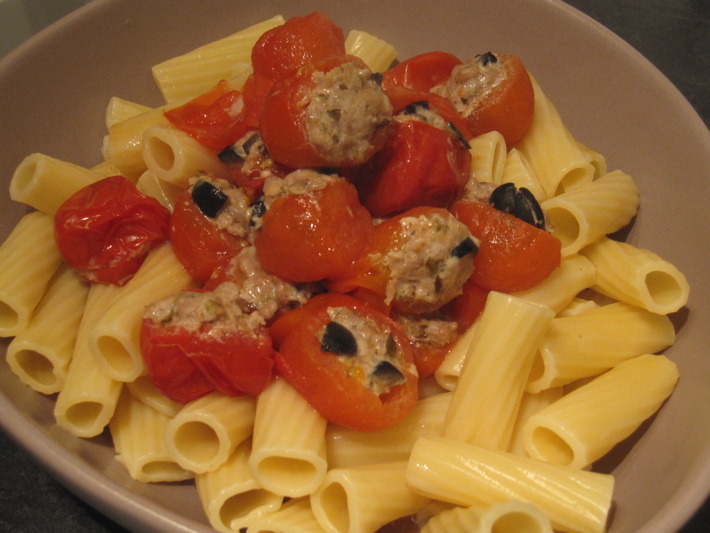
I used about 200g of veal mince, a handful of fresh oregano, about 75g of parmesan and about ten black olives finely chopped and bound together with an egg yolk. I didn’t bother with the usual milk soaked breadcrumbs as I didn’t need the mixture to form such distinct shapes and then I stuffed the tomatoes nice and full. They then got baked for around 35 minutes until soft and collapsed and intensely tomatoey. This was longer than I thought they’d need and when I checked them about 20 minutes in, I added a splash of tomato juice to help steam them quicker. I then served them along with the pan juices on a big plate of pasta.

And they had gone up a notch from tasty to terrific. The tomato was exactly what they needed to set off the flavours perfectly and despite my intentions to only have half the meatballs for dinner, I found myself wolfing down the other portion immediately because let’s face it, there was never really any chance of me saying no to two of my favourite things combined. I enjoyed every single scrap and wished I had twice as many. I did miss the sticky cruncy crust that you get on a fried meatball, but I might just put them in upside down, pan sear them and go from there in future. But really these are the perfect summer supper. Stuff one immediately!