The finished dish… a bowlful of hot cacio e pepe

Pasta & cheese part 2: Cacio e pepe
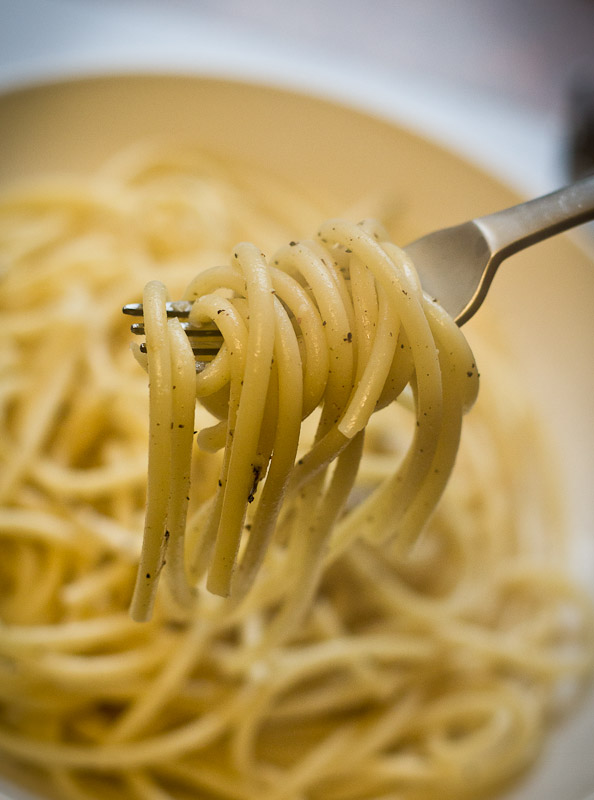
A bowl of cooked cacio e pepe, with fork

This is the second article about the perfect partnership of pasta and cheese; the first being Macaroni (and) Cheese. If you though that sounded good and easy to make, just wait til you try this wee number!

I first read about the classic Roman dish, cacio e pepe, about ten years ago. I think it was in an old River Café recipe in the Guardian. I wasn’t convinced… it seemed just a little too simple and basic… but my curiosity was piqued and I knocked up a portion one lazy evening. I’ve not looked back since, and my fridge always has a small stash of pecorino in it; perfect for a quick bowl of this wonderfully life-affirming pasta dish. It really is the perfect fallback meal.

A bowlful of grated pecorino

Cacio is a local name for pecorino cheese from Lazio, and pepe is as in pepper; and that’s all you need to know in order to bring a bowl of pasta to life. I’ve tried it with fresh pasta too, but prefer the bite and feel of dried pasta, as the cheese sauce works brilliantly with its smoother surface texture. I particularly love bucatini, with its thick, hollow tubes which flex and bow with just the right ‘bite’. I read somewhere bucatini’s the correct pasta for this dish, but it works equally well with linguine or spaghetti too.

A fistful of dry bucatini pasta

The basic components are dead simple, the preparation time is a shade over ten minutes, and it’s a forgiving recipe which anyone can tackle. Bring a good amount of water to the boil in a deep pan. Salt it well – good pasta always deserves a decent dollop of salt to cook it with – and add a generous fistful of pasta per person. I invariably make too much of this for one person, but it always mysteriously disappears as soon as it hits the plate. You just need to cook the pasta as you would expect, until it’s slightly al dente. When it’s done, be sure to reserve a little of the cooking liquid before you drain it (I’ve absent-mindedly tipped it all out on more than one occasion, so now I scoop out half a cup or so to make sure I keep it, before draining). The starch in the cooking water is important, as it helps to soften and melt the cheese.

As for the cheese, in Rome this would be made with the local pecorino Romano. I prefer the stronger taste of pecorino Sardo if I can get it, but either way, the sheep’s milk in pecorino is perfect for melting, and the salty umami flavour compliments the warmth of the pepper perfectly. I’m not sure about quantities of cheese… i grate up enough for a generous helping. Some recipes call for a mix of Grana Padana or Parmesan, and I find this mix doesn’t melt quite as well, but tastes even better than straight pecorino.

Pour a bit of the reserved water back into the pan over a medium heat, stir in the cheese, and watch it melt. It should quickly become a very pale, almost white stringy consistency, bubbling on the base of the pan. At this stage you’ve got to remember two things: this dish needs to be made and served HOT, and served FAST. Stir in the pasta, keeping everything moving quickly, and grind in black pepper.
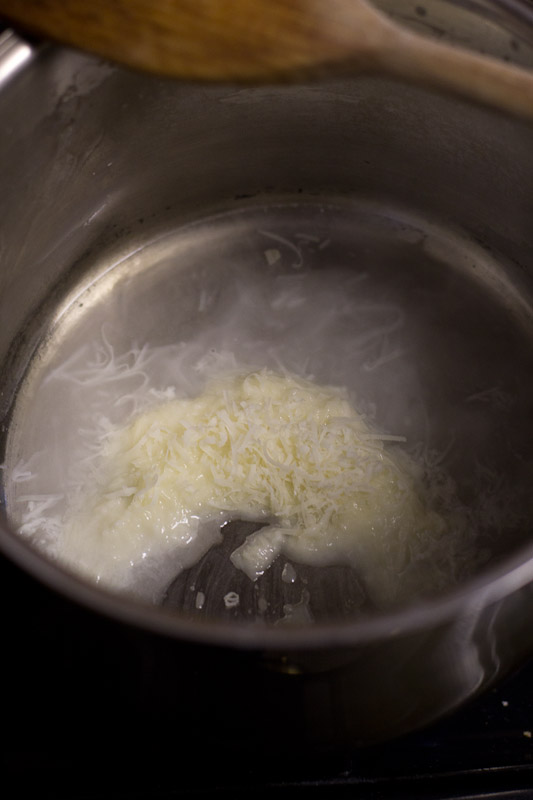
Starting to melt the pecorino

This is important, you really need the fieriness of freshly ground black pepper – don’t use anything pre-ground –  it needs to glow and sparkle with the heady aromatic notes of freshly ground peppercorns. Again, I tend to subscribe to the principle of twist and grind until you think you’re done, then give it a couple more turns for good luck. Give it a bit of welly: your eyes may water but you’ll be grateful for the punch of pepper against the mellow salty smoothness of the cheese. Sometimes I add a twist of mixed peppercorns over the top of the plated dish: the floral pink and green peppercorns give it a lighter, more playful finish.

Get this onto a plate, pronto, and eat it while it’s still piping hot. A slice of good rustic bread on the side is always a plus, to mop up those last errant smears of cheese and pepper., and I can guarantee you’ll have the cleanest plates after this meal. Quality pecorino is a bit like Clint Eastwood: hard, salty, and matures with finesse, so as long as you wrap it properly in waxed paper, and keep it carefully placed in the fridge, it’ll always sit patiently ready for an emergency callout for cacio e pepe.

It’s one of the easiest dishes you can make in a shade over ten minutes… just water, pasta, cheese and black pepper. Magnifico!

The finished dish… a bowlful of hot cacio e pepe

Pasta & cheese part 1: return of the mac(aroni)…

Mmmm, pasta and cheese. Such perfect bedfellows, and the basis for two of my most favourite, comforting and fail-safe meals. After all, it’s hard to beat the double whammy of carbs and dairy products on a cold day. As it feels like winter is knocking on the front door, it’s time to share them with you. this first one is easy, the next is even easier: so there’s no excuse not to try these out for yourself!

Here’s the first of these… it’s macaroni cheese. Perhaps not haute cuisine, but one of my all-time favourites. And to any of our North American readers, I apologise in advance to you: this is the exact opposite of a Kraft Dinner. Miss South was braver than I, and last year experienced boxed Kraft & Mac. Made from powdered cheese: two words which should never be used in the same sentence. Unsurprisingly, she wasn’t a fan. I shuddered at the very thought of it… but then my macaroni cheese has become a signature, sloppy, safe dish; something I can always fall back on when feeling cold or blue. So it’s time to redress the balance and serve up some proper North/South mac!

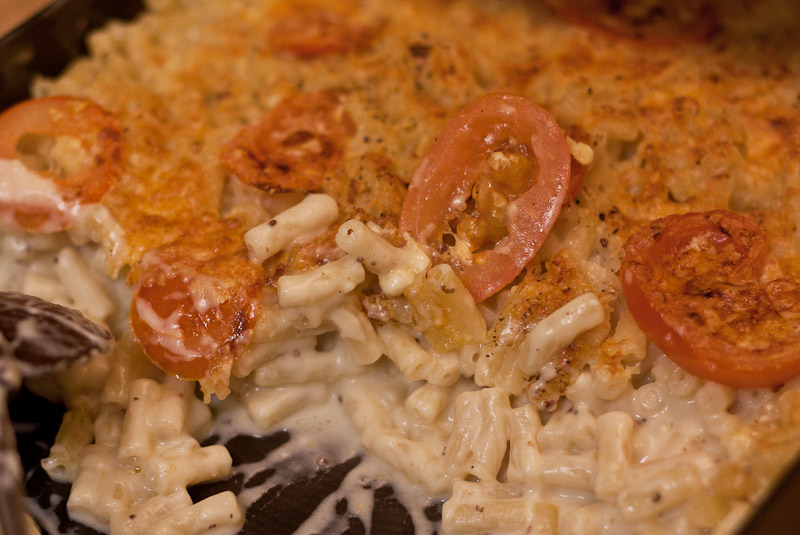
Half-eaten macaroni cheese with tomatoes

Firstly, let’s drop the ‘and’. On this side of the pond, it’s always just been ‘macaroni cheese’. I was heartened to find it’s been a favourite in the UK since Victorian times, no doubt because it’s simple to make, and almost universally appealing. Come to think of it, I don’t think I’ve ever eaten macaroni any other way apart from with cheese. If ever there was a typecast pasta, it’s macaroni. Whole packs must sit at the back of the cupboard, dreaming of being partnered with a cacciatore or arrabbiata sauce. Macaroni wants to be treated like an adult, and I’d like to think I know how to show it a good, grown-up time. There must be something to this: over the years I’ve found none of my guests has turned down my offer of seconds. Or thirds, come to think of it…

So let’s start with the basics… you’ve got to make a white sauce. I’ve got a bit more classical in the last few years, making a proper béchamel by letting the warm milk infuse with a clove and bay-studded onion, before adding it to a roux of butter and flour. But you can keep it simple and just trickle the milk in gently once you’ve stirred the butter and flour together into a smooth paste. The secret is to keep stirring at all times… I’ve been known to walk around the kitchen, stirring the pan as I go, just to keep everything perfect. This might seem excessive (or obsessive), but this is the cornerstone to the whole dish: a superbly glossy, silky, smooth and savoury sauce. And, if like me, you learn how to make this most classic kitchen sauces as a by-product of knocking up a bit of dirty comfort food, all the better. Without a badass sauce of the right consistency, this dish fails, so give it some love and attention. Once you’re confident in doing it properly, you’ll be able to do it with your eyes shut.

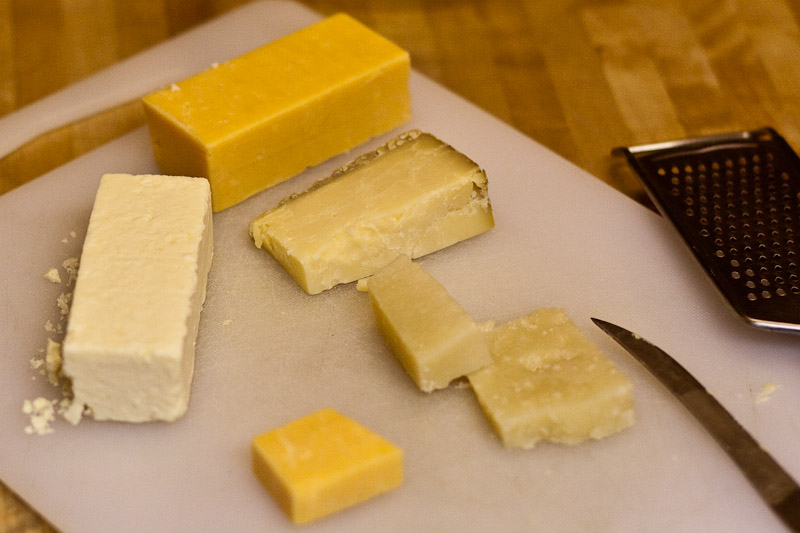
Three cheeses for macaroni

Obviously cheese is the other fundamental to this dish. Apart from the time, still celebrated in our family lore, when our dad managed to omit it altogether (cue whole family confusedly chewing pasta in white sauce, waiting in vain for the flavour to kick in). Generally our mum used to make a killer macaroni cheese, always using mature cheddar to up the umami stakes, giving every bite a good savoury tang. I used to do the same, but over time have settled on a broader range of complimentary flavours. So now you’ll find the sweet nuttiness of Parmesan paired with the kind of tangy Cheddar which makes one’s mouth pucker involuntarily, and a creamily lactic Lancashire to soften everything out. Sometimes a wee bit of pecorino will get added instead of the Parmigiano, or I’ll substitute some local Pike’s Delight for the normal mature cheddar; but the rich elegance of the sauce is best based on a range of cheeses. After all this lactic love, I tend to go heavy on the quantities. My rule of thumb is to grate a bowlful of roughly the same volume of cheese as the volume of dry pasta I’m going to use. Seems like a lot, but you need a decent amount for the topping. As the cheese gets stirred slowly into the béchamel, it’s time to get the macaroni going in a pot of boiling water. Drop in, return to the boil, then reduce to a simmer.

Once you’ve added a good proportion of the cheese (perhaps three quarters of the bowl), and the consistency of the sauce is like a thick custard, it’s time to season. If I was a purist, like the excellent Simon Hopkinson, I’d insist on using white pepper to keep the delicate shade of the béchamel consistent. However I normally add a tablespoon or so of wholegrain mustard at this stage, so some freshly ground black pepper just adds to the speckled appearance, and gives a touch more warmth to the dish. Taste will tell what’s right for you… I like it with a decent amount of poke. A few minutes stirring, ensuring the sauce is rich, flavoursome and thick, and the pasta should be about ready. For God’s sake, don’t overcook it: we’re finishing the dish off under the grill (and in a bed of molten sauce), so slightly al dente macaroni is better then flaccid and overdone any day.

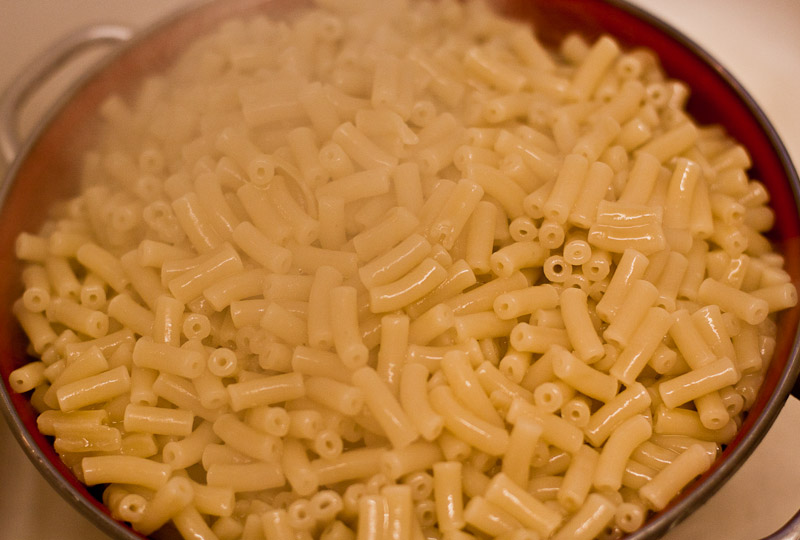
Drained macaroni in colander

Drain the macaroni, take the sauce off the heat, and pour the pasta into an ovenproof dish. Slowly pour over the sauce, stirring well to ensure everything is coated properly, then finish the dish off with a generous topping of cheese. This’ll brown perfectly under the grill, adding a bit more bite and chew to the finished affair.

Mixing up the sauce with the macaroni

It was only a few years ago I weened myself off my childhood delight of a good squirt of Heinz’s Tomato Ketchup on my macaroni: as I was upping the ante with ever more posh ingredients. However our mum always used to put sliced tomatoes on the top to brown. I hated this at the time (sorry mum) but as I’ve got older, I’ve appreciated how the tart and sweet flavour of tomatoes complements the savoury nature of the cheese; so now I’m fully signed up to the tomato garnish. You can make the whole thing look as pretty or as lazy as you like, before bunging it under the grill/broiler until everything bubbles and browns, and you can’t resist any longer.

You’ll only need 25 minutes to knock this up; you can feel good as you’re applying some proper chef skills. Yes, the calorie count is on the high side, but this is winter comfort food, not something for a healthy regime. Don’t even think of skimping on the fat: skimmed milk or lo-fat cheese is wrong on so many levels, and just won’t deliver the big, warming flavours you want. I sometimes add a bit of double (heavy) cream to the sauce for a splash more decadence. Once you finish your portion (and seconds too, because this is one dish I can guarantee you’ll not be able to resist more of) you can always do something wholesome and virtuous, like taking a long walk in the park, or climbing a hill. You’ll be ready for anything. Except, perhaps, dessert.

Candied Peel

I love love love candied peel. I used to run to the baking cupboard and cram spoonfuls of it in my mouth when my mum wasn’t looking. It was my favourite bit of any fruitcake or barmbrack. This is especially odd since I don’t like oranges as a fruit, juice or flavouring, and generally eschew citrus fruits of all kinds. But mellow those citrus rinds in vats of sugar and it’s hypnotic to me.

An inability to read recipes a few weeks ago meant I ended up with an overabundance of grapefruits when making marmalade for cake and found myself wondering what to do with them all. A casual Twitter conversation about Christmas preparations brought about a massive lightbulb moment. I would make my own candied peel. Never mind if it was incredibly faffy and complicated: I could rise to the challenge!

Imagine my glee when this Waitrose recipe popped up and I realised candying my own peel was actually easier than pie. Radio on, sleeves rolled up, I set about peeling and de-pithing my citrus fruit. I had a mix of pomelo, ruby grapefruit, lemons and orange, but avoided limes as I thought it might be too overwhelming, like cordial.

Get four pans going on your hob and simmer the peels separately in hot water for about 20 minutes to soften them up. Then split the peels into two pots to simmer in the syrup. I actually made two batches of candied peel and found it easier to keep the peels bigger and cram less peel into the pans as they bubble and soak up the sugar. I just did two batches of the syrup to be sure nothing caught or burned. Keep the heat down low as you can, you only want the merest blip in the syrup to stop it getting bitter or caramelising. Then go off and do stuff while your house smells truly amazing…

I came back to my peel when there was still a tiny bit of syrup left, and lifted the biggest pieces out with tongs, laying them on baking trays. The smaller bits went into a sieve to drip any excess syrup off, as you don’t want so much syrup on the pieces: they dry crunchy and I didn’t fancy trying to boil my pan dry and win the challenge. I then left the trayfuls of peel in the living room to dry as it was the only place I had room, but the airing cupboard or anywhere the cat can’t walk on them will do.

About three days later, I turned the peel with tongs and left for another two or three days or until I remembered about it. I popped it in a ziplock bag, with a tablespoon or so of icing sugar, and shook it up to coat it and stop it sticking together. Some went into the Christmas mincemeat. Some went into cellophane bags to give as gifts. The rest was stored in a jar to be used for various festive recipes closer to the time and the leftover syrup stored for a drizzle cake or put on porridge or ice cream.

So if you didn’t do a cake on Stir-Up Sunday, impress people with homemade candied peel instead. You will never buy one of those tiny tubs again after you’ve tasted the citrus sensation of making your own. It tastes as good as it looks!

Polishing off Polish Pierogi…

Several things are guaranteed to bring a tear to my eye: the episode of ER where Mr Mark Greene dies, posters for lost stuffed animals and family pets and the thought of ever having to go low carb and stop eating potatoes.

I really don’t care how big an Irish cliche I am. I love spuds with all my soul. What other foodstuff is so versatile, so easy to work with and to grow yourself? There is just no thing as too many potatoes in my life and that is why I love pierogi so much. A dumpling stuffed with mashed potato? Hello there! Dumpling is the magic word in my world, especially when you can fry them in butter to add even more of my favourite things to one dish.

There are as many recipes for pierogi as there are types of spuds and Polish families, but I used this one from Post Punk Kitchen as I wanted a dairy free recipe for a friend with intolerances. (I find specifically dairy free sites seems to rely heavily on soy or nut ‘milk’ based products and I would sooner die than use soy cheese. Vegan sites tend to seek other options and skip the processed stuff most of the time so I prefer them.)

I cannot pretend to have solved the eternal dilemma of translating American potato recipes to our varieties and found a total replacement for Yukon Golds, but find that if all else fails, a Maris Piper is the answer, although I used the last of my own Pink Fir Apples from the veg patch. I also won’t lie to you. This recipe is time consuming, but actually very easy to make. So stick Radio 4 on, roll up your sleeves and get pottering in the kitchen this weekend.

First up, choose your filling. Pierogi can be stuffed with anything. You can do some with spud and some with just about anything of your choosing. Sauerkraut is popular. I fancied pumpkin and sage to be seasonal. Black pudding would be brilliant. But feel free to use anything you desire. Leftovers would be perfect here. I went for sauteed mushroom with tarragon and mashed potato. Just cook as you normally would, but make your spuds are nice and dry before you mash them.

Once the filling is decided on, you’ll need to get going with the dough. This is dead easy. An American cup is approximately 240ml which equates to about 110g of flour, but if you’ve got measuring cups, stick to those. I used plain flour here and needed to add all three full cups of flour to stop the dough being too sticky to get out of the bowl. I added another two or three handfuls to it as I was kneading too.

After about ten minutes of kneading, the dough will be smooth as anything and lovely and elastic. This requires little skill, just some concentration and a bit of time. At this point, you can either store the dough overnight covered in the fridge until needed or get on with making dumplings.

Flour the surface and dough well and roll it out as thin as possible. Mine needed to be a tad thinner than they were, but I still got 45 pierogi out of them so be prepared to have an invasion of dumplings! Cut out circles of dough with a cutter or glass and then get filling. I put about a dessertspoonful of mushroom and potato in each one, brushed the edges with water and pinched shut, making sure the ends are nicely closed. That’s it. Super simple. Easy enough for little hands to do too.

Once I’d cut, filled and pinched half the dough, I boiled six or so pierogi in a big pot of water for about four minutes or til they float. You can served them simply boiled or you can take it up a notch by frying them off for a golden crunch. Drain them onto kitchen towel if you’re doing that and then pop into a pan of hot fat. While they fry, deal with the other half of the dough. I used up the full 500g of spuds I mashed and half a punnet of chestnut mushrooms to fill all of them, but could have done with twice the amount of fungi.

Once your dumplings are fried, pop in the oven to keep warm and keep going in batches until you’re ready to eat. I served for dinner, sprinkled with truffle salt and fresh tarragon to keep them simple but dairy free, although they’d be great with sour cream too. The other half went onto lined baking tray to cool and go into the freezer until needed.

So after all that time and pinching, were the pierogi worth it? Oh yes! With bells on. Surprisingly light dough with the smoothest creamiest mashed potato possible, despite not a drop of butter, oil or milk in it, all made better by frying them off. I managed 9 of them before passing out in a carb coma, but managed to go back for more for dinner the next night, adding some pan fried breadcrumbs for extra crunch.

A super easy, surprisingly relaxing recipe to make, I urge you to get your dumpling on as soon as. You’ll have a great meal that will impress anyone straightaway and enough to do several quick dinners when you can’t be bothered to cook another night. Dumplings don’t get better than this!

Twice as nice… our daily bread

It’s said man cannot live on bread alone. Considering this statement, I’m surprised organised religion remained so popular for so long on our wee island, when you think what a cracking range of Irish breads there are (veda, potato bread, soda farls and wheaten bread amongst others). I’m all for a bit of decent bread, slathered with butter, rather than some dour sermonising or happy clapping. I’ll probably be smitten down by the hand of a deity for saying that, but at least I’ll go with a smile on my face and a full tum…

Sundays are ripe for laziness*, cooking, and loafing around the house. Today’s mission was to make a decent and homely wheaten bread, to help counter the autumnal blues outside. However we’d been out drinking in Leeds yesterday (sampling some great ales from Leeds and Ossett breweries amongst others), and after a late night and a fuzzy head this morning, something special was required for breakfast first.

I’d planned to make baked eggs, following the recipe from the Parlour Café Cookbook. These have rapidly established themselves as a brekkie standby, not least because they’re so easy to cook. Their simplicity belies their deliciousness. I swapped the Parma ham from their original recipe with some slivers of locally hand-crafted air-dried ham from my friends at Porcus. Their rare-breed pork is heavenly, and I’m privileged enough to get samples of their splendid ham from time to time. These were perfect to line the ramekins, before cracking a hen’s egg in each. But I felt I needed something a tad more substantial to accompany these, so I made some potato bread – a family favourite – for the first time ever.

As Miss South’s previously explained, it’s meant to be made with leftover mashed potato, but that’s rarer than hen’s teeth in my house, so I quickly cubed and boiled up a few spuds, ran them through the potato ricer, then mixed in some plain flour & a knob of butter to create a light dough with a bit of bite. Proportions may vary depending on how waxy/floury your spuds are, but normally you want 4 to 5 times more flour than mash. Miss South’s said it before and we’ll say it again: potato bread is dead easy… it takes a Herculean effort to mess it up. A perfect compliment to any kind of ham and eggs…

Wheaten bread, otherwise known as brown soda bread, is another one of those wonderfully yeast-free breads we love back home. As with soda farls, the secret is the baking soda which helps it rise. You can buy it in many supermarkets, ready-made and branded courtesy of Paul Rankin; and both it and the more well-known white soda breads are gaining popularity on this side of the water. No wonder, it’s both healthy and oh-so-tasty. The ever-reliable Dan Lepard popped up on Women’s Hour’s “Cook the Perfect…” last week with his own take on it, and this spurred me on to do it the North/South way…

We’re a bit more old school in our family, and the core ingredients for wheaten bread are normally just flour, buttermilk, baking soda, and a pinch of sugar. Wheaten bread’s at least as easy to make as potato bread, especially if you have some Northern Irish wheaten bread mix to hand (thanks to my mum for bringing some across this summer). Of course, you can instead use a good mix of plain and wholemeal flour instead… but try and use as coarse and bran-heavy a mix as possible, as this really contributes to the flavour. In a mix, the baking soda’s already in place, so today all I had to do was add buttermilk and sugar.

I’m lucky enough to be able to get buttermilk in my local Morrisons, but I hear it’s hard to source in many parts of the country, so you can use full-fat milk and sour it with some lemon juice, or mix in some live yoghurt instead. Use roughly 3 parts flour to 2 parts buttermilk… in this case I used 500g of flour and about 330ml buttermilk, with a teaspoon of caster sugar just to bring out that nuttiness of the bran even more.

Mix it all up until you get a nice dough, not too sticky or overworked. Then normally I’d roll it out into a roundish shape, about 1″ / 3cm thick, before scoring the top into quarters. I dusted it with a little plain flour, but it’s also good finished with some chopped rolled oats.

As I was mixing the dough I realised I’d not made this for far too long; in fact since I went to Rotterdam to visit friends from all over Europe and enjoy a good shared meal. My Italian mate knocked up some fantastic food, so I thought it’d be right to bring a decent Irish loaf to add to the mix. Most people smuggle addictive substances out of the Netherlands: I may be the only person to have smuggled a loaf of wheaten bread in!

This is a bread with instant gratification in mind, with no leavening or proving required. I baked this straight on the shelf in a pre-heated oven, rather than on a tray, for 35mins (200C/400F/Gasmark 6) straight. Once it came out, sounding hollow when tapped, it had to sit and cool down on a wire rack. This is one of my strongest kitchen memories as a kid. I used to hang around, greedily watching while my mum baked glorious bannocks of wheaten bread, but the hardest part was waiting for them to cool, far too slowly, on a wire rack, with a tea towel covering them. As I found out today, self-control still isn’t one of my strong points when it comes to wheaten bread, even after all these years. We succumbed while the bread was warm enough to melt great slatherings of butter.

Simple and effective with good butter, though I had a last-minute hankering for a bit of blue cheese, which works so well with the nutty sweetness of the bread. Cashel Blue would be the natural Irish choice, but I was able to pick up some very decent Jervaulx Blue instead, which I enjoyed along with a pot of Yorkshire Tea. Living just inside West Yorkshire, it seemed a perfect choice. It also makes superb toast. If you’re looking for something a little more special, slices of buttered wheaten bread alongside some good Irish smoked salmon, finished with a sprig of chervil, a squeeze of fresh lemon juice and some cracked black pepper is to die for.

*”Oh wheaten it be nice…” with apologies to the Small Faces…