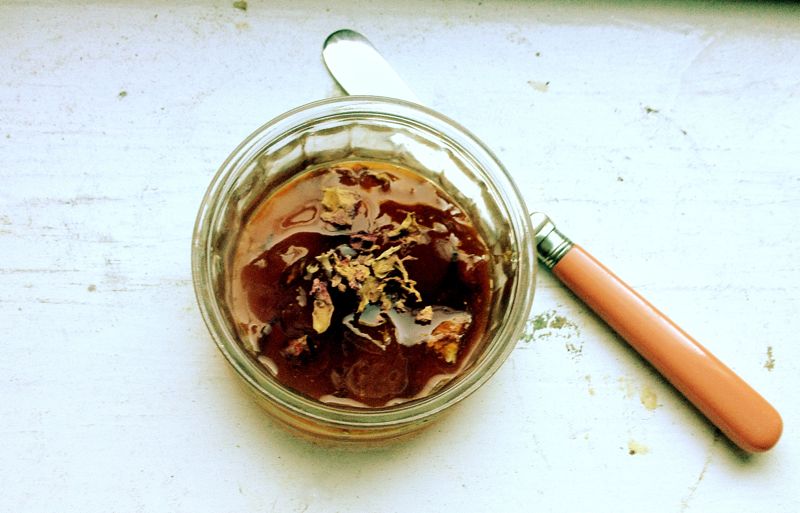
Date Ripple Ice Cream

A few months ago, my eye was caught at a local shop by a branch with what looked like yellow velvet mini apricots on it. A sucker for slightly Disneyfied foods, I picked a branch up and enquired as to what it was of the shopkeeper. He explained that they were fresh dates, brought in for Ramadan when iftar or the breaking of the fast is traditionally performed with a date and water. Not only do they look fabulous, they are less sweet than dried dates, so I thought I’d definitely give them a go. A bit of Googling told me they are known as barhi dates and that they are pleasantly fresh and cleansing.

Forgoing the small sherry I often have as an aperitif, I decided to try a fresh khalal date instead. Plucked from the branch, they were as silky smooth as a perfect peach with a serious crunch when I bit into it. And then all the moisture was sucked from my mouth in a startling fashion that pursed my lips like the Grandma in George’s Marvellous Medicine. My mouth felt as if it was first thing in the morning after a heavy night on the sauce and as if I’d scoured it out with oxalic acid for funsies first. My teeth were on edge, my mouth tasted foul and I had to brush my teeth several times to remove the sensation. It was one of the worst things I’ve ever eaten.

Sulking slightly, I left the dates to sit on the windowsill as punishment for letting me down and went away for a few days. When I came back, the dates had wizened, shrunk down and deepened in colour to a wonderful glossy shade of amber that just gleamed with natural sugar. They looked much more appetising than those lifeless things you see in trays around Christmas with their own fork. I ate quite a few just off the branch and revelled in their candy like feel, but wondered what else I could use them for. As usual, when in doubt, I thought ice cream…

Read more

Maple Rosemary Popcorn Pie

Maple Rosemary Popcorn Pie

Maple Rosemary Popcorn Pie

At this time of year, although Hallowe’en is to me a very Irish celebration, I do like a spot of Americana in my stomach as the autumn nights draw in. Glorious orange pumpkins, soups and stews spiked with smoky frankfurters or the same sausages battered and served up as corndogs, glistening sticky pecan pies and handfuls of crispy popcorn. They seem to have the right flavours for the season and sheer greed and a slightly abstract conversation made me wonder if I could perhaps multi task and turn the latter two into one dish for ultimate eating?

I wanted something slightly more grown up that the crunchy toffee coated popcorn I so desired as a child on cinema trips which now seems sickly sweet and artificial. Reading recipes for caramel corn made me think mine needed the adult twist of sea salt for sure,  but I wanted something else to lift it and my memory went back to this lovely post for Rosemary Sea Salt Millionaires’ Shortbread that I’ve been meaning to make for yonks. Seeing that my rosemary bush was the only thing in the garden to survive the summer of slugmageddon decided it for me and that woody floral flavour would be my secret weapon.

Maple Rosemary Popcorn Pie: makes one 9″ pie (or 4 small ‘uns with tonnes leftover like me)

  • 250 g sweet shortcrust pastry
  • 3 tablespoons popping corn
  • 1/2 teaspoon coconut oil
  • 100g unsalted butter
  • 50g golden syrup
  • 50g maple syrup (use all golden if you don’t have maple)
  • 150g golden caster sugar
  • 3 eggs
  • large pinch of sea salt (enough to just taste the salt)
  • tablespoon chopped fresh rosemary

First start with your pastry. You can just use bought stuff for this, but if you’re making your own, may I recommend the sweet shortcrust by Dan Lepard in Short and Sweet? I’ve always had issues with my pastry shrinking no matter how well I chill it and this recipe is foolproof. I’m not going to write it all out because Dan explains it well elsewhere if you search, but really because if you’re buying a cookbook, it should be this one. Call it an early Christmas present…

Line your tart tin and chill the pastry again before blind baking for 15 minutes at 180℃ or until just colouring the palest golden shade. Leave to cool while you make your filling.

Place three tablespoons of raw popping corn kernels in a paper bag (I use leftover flour bags) and the smidge of coconut oil and fold the bag over loosely and microwave for about just under 2 minutes (I usually whip it out at 1.45 or it starts to burn) and voila! You have the quickest easiest popcorn possible. If doing something as delicious as this just carry as normal, but you’ve skipped the whole washing up stage.

Now melt the butter, sugar and syrups together in a pan. I’ve used unsalted butter because it’s too easy to overdo the salt with regular butter and then adding more salt, so have gone for a blank canvas, but obviously, you can improvise if you only have salted butter. Take the mixture off the heat and add in the chopped rosemary and the salt. Allow the mix to cool for about 10 minutes. Don’t skip this stage or your mix will be so liquid to pour in the case, you’ll stick everything in the kitchen to itself, you and the tart case as I did the first time.

Once the mix is cooled slightly, beat the eggs in it. They won’t curdle now you’ve reduced the temperature of the mix. Then stir the popcorn into the mix. You’ll need to do this fairly carefully and repeatedly as popcorn floats quite well and resists dunking unless really coaxed. I originally used this caramel corn which made it easier, but a) really isn’t very nice or worth the washing up and b) made the pie so sweet, the Scottish person I tried it on couldn’t eat it. Once your popcorn is entirely coated, pour the filling into the tin making sure you don’t overfill or the whole thing will stick. Bake the large case at 180℃ for about 40 minutes whereupon it should be golden brown but still slightly soft in the middle.

Remove from the oven and allow to cool and set slightly. Both this pie and the pecan pie it’s based on are best served slightly warm but not hot unless you want to remove several layers of skin from your mouth with molten sugar. This pie calls out to be served with clotted cream or really good vanilla ice cream. Just don’t expect as much crunch as pecan pie and you’ll love it. The popcorn is both soft and sugar coated crisp and the filling is like proper butter toffee with bite. The salt should be just enough to enhance the sweetness and the rosemary adds just enough interest to leave you guessing what the extra flavour is. Once I’d toned the sugar down, this was great.

If you like popcorn, you’ll love encasing in butter, sugar and syrup and then crisping it right up. If you don’t love popcorn, you’ll think this is just another American oddity, but to be honest, that’s why I rather liked it!

Chocolate Liquorice Cake or how to perk up a prune…

The last few weeks have been a bit of a blur of new tastes and food experiences and travel and general activity. I’ve had great company and great meals, but I’ve been yearning to get back in the kitchen and play with my new finds. Mister North had very kindly shared some of his Lakrids Liquorice Powder from a Harvey Nicks bloggers’ lunch and I was intrigued as to what on earth to do with it since the package gives no clues and the site is entirely in Danish and my Sarah Lund fixation really only gives me rudimentary Danish vocab for the world of crime, not cooking.

I’d been eyeing up this David Lebovitz chocolate and prune cake for a while. Luscious with dark chocolate and butter, it’s a flour free number with a squidgy mousse-like consistency and having never made a cake like this before, I couldn’t wait to give it ago. I decided to give it an extra edge by adding some of the liquorice powder to the cake as liquorice is many times sweeter than sugar and I liked the idea of using it to smooth out the sharpness of the dark chocolate and give the prunes an extra earthiness.


I’ve linked to David’s orginal recipe so you can just follow that or you can do what I did and misread it and thus go about it slightly differently and awkwardly. Your call, but be aware my version gives you an excuse to drink some rum as you go…

Chocolate and Prune cake (from David Lebovitz, tweaked by me)

  • 170g pitted prunes
  • 80ml dark rum (or other dark spirit of choice)
  • 1 tablespoon sugar
  • 340g dark chocolate, chopped
  • 6 large eggs, separated
  • 170g butter
  • 3 tablespoons sugar
  • 2 tablespoons raw liquorice powder

First prep your prunes. I cut mine into quarters and then soaked them overnight in the rum and sugar because I obviously thought I was making a tealoaf instead of reading the recipe properly. However, if I’d done it properly, I wouldn’t have discovered how good rum soaked prunes on my morning porridge…

Then butter a 9 inch cake tin (preferably springform). I also used cocoa powder on it and the cake stuck more than usually happens in my tin so I’m not sure I’d do that again.

I melted the chocolate and butter over hot water, stirring well to make sure it was well melted and glossy. I took it off the heat and added in the prunes and remaining rum which cooled the mixture slightly which meant I could add the egg yolks without fear of scrambling them. Pop the liquorice powder in at this point.

Whisk the egg whites until stiff and firm, adding the sugar gradually and then fold them into the chocolate mix a third at a time, making sure you don’t overbeat and knock all the air out of the batter. Pour it into the tin and bake at 170℃ for 40-45 minutes. You can’t use the old skewer trick as the cake rises massively and the centre should be slightly soft, but the edges are pulling away from the tin. Cool well and you’ll notice the cake settles back down again in size.

David Lebovitz says the cake can be made up to three days in advance. I made mine two days in advance and kept it in a tin and felt that actually it was a touch dry round the edges, so I’d say wrap it well in a tea towel to be sure.

The cake was worth waiting for, very grown up with the bitter edge of dark chocolate,  sticky and squidgy with nuggets of prunes and completely and utterly lacking in any hint of liquorice at all. I couldn’t taste it and I’m presuming the others who ate it couldn’t either as no one asked what the other flavour was or if there was a magic ingredient. It didn’t even sweeten the cake particularly as the one question that was asked was if there was any sugar in the cake at all. I actually really enjoyed the lack of sweetness, which is unlike me and my common milk chocolate eating ways, but was disappointed by the Lakrids.

This is the second dish I’ve used it in. Once sweet and once savoury, and I couldn’t taste it either time. I’ve bookmarked this recipe as my go to quick chocolate cake, especially for gluten free folk, but I’m not inclined to persevere with the Lakrids, unless someone can give me a really good idea for it or takes me quietly to one side and explains that I’ve been doing it wrong…

Apricot and Rosewater Conserve

Apricot and Rosewater conserve

It was inevitable after my marmalade making fun earlier this year that I would enter the jam making world as well. It came about accidentally when after buying some plump looking apricots in the market as a change from the constant stream of flat peaches and white nectarines, I bit into one and all I could think was ‘cotton wool’. The apricot is a fruit has doesn’t work for me unless it’s cooked. I roasted the rest of that batch, scattered with rosewater and flaked almonds and they were fantastic on bircher muesli.

But after a Twitter conversation with the lovely @RachaelParkman who is the Peckham preserve queen, I decided my first foray into jam would be apricot so that the taste of summer would remain at my table for months to come. Plus it makes such a good base for cake decorating, I might do more marzipan making.

I turned to my preserve Bible ‘Let’s Preserve It‘ by Beryl Wood which was reissued recently in hardback and it’s delightfully British and excellent on jams and conserves. (For the record, jams are cooked down fruit puree, while conserves retain chunks of fruit in with the puree.) I must say, I only picked the conserve recipe because it used less sugar and I’d brilliantly managed to tip a good amount of my kilo bag down the side of the cooker and into the box of mouse poison there and couldn’t be bothered to go to the shop for more…

Apricot and Rosewater Conserve: makes about 6 jars each 160ml*

  • 900g (2lbs) fresh apricots
  • 900g sugar
  • 1/4 pint water
  • juice of two lemons
  • 2 tbsp rosewater
  • 2 tbsp rose petals (optional)

Make sure your apricots aren’t bruised. Soft ripe fruit is fine, but don’t use fruit you wouldn’t eat yourself or it can make the conserve bitter. Wash well. Stone the fruit and then cut each half into quarters.

Put the fruit in a pan with the sugar and the lemon juice and and heat gently along with the water until it is boiling gently and then continue boiling until it starts to set. This took me about 30-40 minutes while the fruit broke down into a pulp and the sugar and water became syrupy. Stir frequently. I then used the good old wrinkle test on a cold saucer and then took the pan off the heat.

I added in one tablespoon of the rosewater and tested another snippet of the jam on the saucer until it cooled and tasted it. It wasn’t quite enough so I added a second scant spoonful and then added in the rose petals. I’d sprinkled these lightly with water so that they didn’t float in the conserve and stirred them through well before filling my jars as usual.

This was very easy to make and lifted some uninspiring fruit to something really wonderful. The rosewater brings out the apricots’ sweetness and makes this a very grown up addition to the breakfast table. I love the texture with its chunks of fruit instead of the sticky-sweet nature of commercial preserves. I’ve been heaping it on toast and enjoying the summer flavours as the season changes…


*I use Sainsbury’s Basic Mint Sauce jars. Under 30p a jar and a useful marinade, they are the best way I’ve found to get standard sized jars for jam and marmalade that aren’t huge or very expensive. Plus I enjoy the look on the delivery driver’s face when he hands me 14 jars of mint sauce.

Vietnamese Coffee Ice Cream


Last month I finally got the chance to try an iced coffee for the first time since an ill advised carton of Nestle Frappe back at primary school which scarred me for life (I think it’s where they got the idea for that 3 in 1 monstrosity they were pushing at Tube stations recently). This time I showed more sense and went to the Vietnamese cafe Banh Mi Bay and sampled this summer drink made by the people who do it the best.

Strong, but not bitter and slightly sweet from condensed milk, it was so refreshing I couldn’t stop thinking about it. I wanted to re-live its cooling caffeine hit and when Kavey mentioned that July’s Bloggers Scream for Ice Cream challenge was a condensed milk custard, I knew what I had to do…

Vietnamese Coffee Ice Cream (makes about a litre)

  • 410g can of condensed milk or two small cans (Polish shops usually sell the bigger ones & are great value)
  • 3 tablespoons freeze dried coffee dissolved in 60ml of water, cooled slightly
  • 5 egg yolks
  • 250ml double cream
  • 250ml whole milk
  • pinch salt
  • freeze dried raspberries (optional)

First make your coffee. You’re probably having kittens at the thought of using instant coffee, but I always keep some in the house for baking and cooking as you want a good strong coffee flavour without too much liquid and proper ground beans don’t do this. If you really object to the instant stuff, this is a good time to try cold brewing coffee and using the concentrate that method creates instead. I wasn’t organised enough so instead I used 3 tablespoons of freeze dried espresso powder in 60ml or 1/4 cup of boiling water and left to cool a bit while I made the custard. I find when you freeze ice cream it lessens the flavour and I like a proper coffee kick from my custard so heaped the coffee in.

I warmed the cream and whole milk, adding in the condensed milk so it all melted and looked like thick creamy custard. I separated the eggs and beat the yolks, adding in a bit of the condensed milk custard to temper it before adding it all back into the saucepan to thicken. Add in the coffee and the salt and str until blipping gently and thickening nicely. It’s like a regular ice cream custard base but much easier to do without splitting or it not coming together. Chill well. It will look as set in the bowl at this point as pannacotta and will be a little bit difficult to get into the machine without ladling.

From reading the expertise of the people organised enough to get their posts up on Kavey’s blog in time, it looks like you could freeze other condensed milk based custards without a machine because of the texture of the custard is airier than usual and wouldn’t just make a big icy block (see her comment below). I used my machine as normal as this is egg based and while it was churning, turned my attention to the garnish.

I adore coffee and raspberries together. The tang of the berries works especially well with coffee desserts and I decided I wanted to cut through the richness of this ice cream with a sprinkle of freeze-dried raspberry. Unfortunately I wasn’t organised enough to mail order these and instead spent an afternoon trekking round London trying to find them in Whole Foods and Waitrose and Fortnums and not getting very far. Instead I bought a bar of 36% cocoa milk chocolate with raspberry from Marks and Spencer and took my frustration from my failed shopping trip out on it with a rolling pin.

I sprinkled some crushed chocolate chunks into each section of my silicone tray and poured the ice cream in, topping with more crushed chocolate and freezing as ice cream bars. I served these between wafers and the crunch of these and the chocolate chunks made the ice cream seem even creamier than it was. Not to toot my own horn, but this was the best coffee ice cream I’ve ever had and coffee ice cream is my favourite…