Homemade Buffalo Curd Cheese…

I’m going to confess something. You’ll either nod sagely at my bravery or recoil in horror and never speak to me again. I’m just not that into cheese…

That’s not to say I don’t ever eat it. I’m partial to a nice slice of Jarlsberg (the holes make it taste better). I keep Parmesan in the house to add some extra umami to everything. And I’ll eat cheese at other people’s houses, but I never think to buy it and I never crave it. It just doesn’t tickle my fancy the same way a nice salami does. So I’m as surprised as you are that I made my own cheese last night.

My eye was caught by Hugh Fearnley Whittingstall’s column in the Guardian the other week explaining that making certain types of cheese at home is a walk in the park. I imagine cheese to be a combination of dairy and witchcraft so this intrigued me. And then I happened to come across a bottle of rennet in Waitrose* the very next day and the spell was cast. I was going to make my own curd cheese!

It is ridiculously simple. You need some non-homogenised milk, some rennet, a pinch of salt and some muslin or ahem, cheesecloth and then you can get going with a few small pieces of attention to detail. You should be able to get non-homogenised milk at a Farmers’ Market but if you want to do raw or unpasteurised milk for whatever reason, then source yours through Duchy Originals at most major supermarkets or try some of the suggestions here. And while you’re at the supermarket, follow this excellent tip from the comments on the original article and pick up a pack of muslin squares from the baby aisle. Much larger than the trendy facecloths around, you’ll get about 5 for a fiver and can use them for cheese making or the forthcoming preserves season. Just iron before use to sterilise it.

I was using raw buffalo milk from Alham Wood Farms and I was surprised to see just how creamy it looked in colour and texture. Much more like the milk when I was a kid and most appetising looking. I heated it to 38° with the aid of a thermometer and then added the rennet. I think I used a touch too much, around a quarter of a teaspoon to a pint of milk, but a little bit extra splashed in so I suggest you measure carefully and not above the milk itself if your hand isn’t too steady. I stirred it in well and then left it for 15 minutes to separate into curds and whey while I got on with a batch of lemon curd.

And when I came back, it really was like magic. What had been thick creamy milk was now a slightly unappealing layer of watery liquid and something that did look quite cheese like already. I scooped the curds out with a slotted spoon into the muslin and tied onto the kitchen tap to drain and set for around three hours, dispensing with the whey completely. This is all you need to do. I won’t judge you though if like me you keep going in and staring at it as if hoping to catch a glimpse of the alchemy as it happens.

About three hours later, when I could wait no more, I unwrapped my little milky miracle. And it looked like real, honest to goodness cheese! Possibly a little bit firmer than it was meant to be due to the extra splash of rennet, it looked like cottage cheese with the firmness of mozzarella. I served it crumbled on some green lentils and homegrown tomatoes and it was stunning. Slightly bouncy, with a touch of saltiness while rich and creamy, it turned some placid pulses into something rather racy as it melted slightly and soaked up the juice from the tomatoes.

I couldn’t get over how delicious it was and how unlike the shop bought equivalent in flavour and depth. That’s probably the buffalo milk but I like to think it’s my natural cheesemaking skills. On an effort to taste ratio, it scores maximum points. I enjoyed it so much I had exactly the same dinner the next night as well and probably would have done so a third night had I not run out of cheese. Had I been able to get my hands on some more milk, I’d have made more and served it on my favourite black pepper infused crackers from Ryvita. I might even have remembered to photograph the meal instead of gorging myself. I think it’s safe to say I finally get the cheese obsession. I’ve come over the dark side of dairy…

*which happened to be vegetarian on closer inspection.
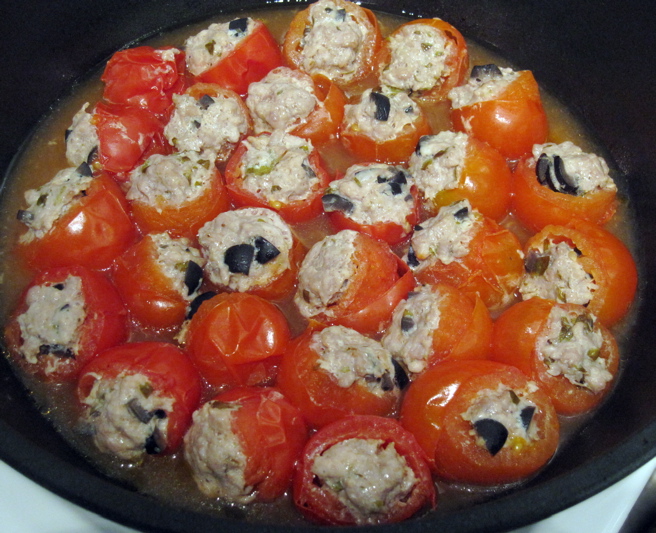
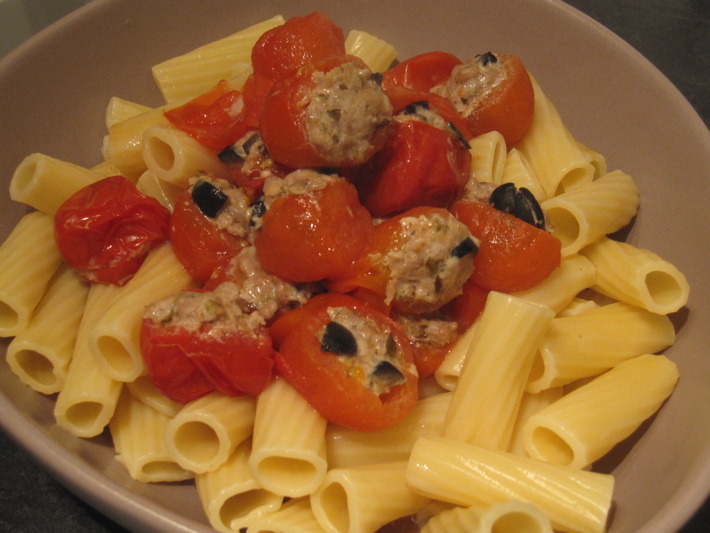
Meatball stuffed tomatoes

There are somethings I never tire of and could eat for all eternity and one of those things is meatballs. I just adore them. Served with spaghetti, stuffed into a sandwich, as a canapé or just on their own, I can’t get enough of them. I usually use Allegra McEvedy’s failsafe recipe from the first Leon cookbook, but as the sun slowly came out over London a few weeks ago, I fancied something lighter and more summery. A chance encounter with some veal mince at Waitrose helped focus the mind and the next thing I knew, I had a plateful of veal, black olive and parmesan meatballs chilling in the fridge.

Pan-fried until well sealed and then steamed with stock until fully cooked through, I served them with some grilled courgettes and the pan juices for a treat of a Friday night dinner after a long week. And they were good. The sweet meatiness of the veal was enhanced utterly by the umaminess of the parmesan and the olives. I scraped the plate clean in record time and even recommended the combo to the little loaf on Twitter. But something was missing. It needed something to take it from good to amazing.

It had to be tomatoes. The July sun and heavy rains of the past few months mean that everything is better with a British tomato right now. Bursting with flavour and warmed up naturally by the flickering sun, they add a note to every dish that lifts it beyond just good. But even having decided on the welcome addition of tomatoes, it still needed something beyond just a sauce. And flicking through some stored up summer recipes, I saw an idea for stuffed beef tomatoes and it all fell into place. Meatball stuffed cherry tomatoes…

As I’ve mentioned before, my life is never too short to stuff anything. Not when everything is more delicious filled with something else. Taking the tops off and scooping out the middles of the cherry tomatoes is in fact no more time consuming than rolling individual meatballs and chilling them into shape. It’s almost as relaxing in fact.

I used about 200g of veal mince, a handful of fresh oregano, about 75g of parmesan and about ten black olives finely chopped and bound together with an egg yolk. I didn’t bother with the usual milk soaked breadcrumbs as I didn’t need the mixture to form such distinct shapes and then I stuffed the tomatoes nice and full. They then got baked for around 35 minutes until soft and collapsed and intensely tomatoey. This was longer than I thought they’d need and when I checked them about 20 minutes in, I added a splash of tomato juice to help steam them quicker. I then served them along with the pan juices on a big plate of pasta.

And they had gone up a notch from tasty to terrific. The tomato was exactly what they needed to set off the flavours perfectly and despite my intentions to only have half the meatballs for dinner, I found myself wolfing down the other portion immediately because let’s face it, there was never really any chance of me saying no to two of my favourite things combined. I enjoyed every single scrap and wished I had twice as many. I did miss the sticky cruncy crust that you get on a fried meatball, but I might just put them in upside down, pan sear them and go from there in future. But really these are the perfect summer supper. Stuff one immediately!

Veda Bread Ice Cream

July is a hot month back home in Belfast. Not especially due to the weather, but because of the slightly heightened feeling on the streets due to the Orange Order marches held in what is known as the Twelfth Fortnight. This was the traditional summer holiday for the shipyard workers in the city and a chance to hark back and remember Catholics and Protestants knocking the pan out of each other at the Battle of the Boyne in 1690. For those of us who don’t enjoy some light civil disobedience, it’s a good time to potter around at home doing all those things you’d sort of meant to do all year since you can’t really go out. Or ignore them completely and spend time watching box-sets and eating ice cream instead…

Feeling oddly left out here in London, I thought I would try and join in with a ice cream recipe with a taste of home. I’ve been wanting to make a traditional brown bread ice cream since I got my ice cream maker earlier this year, but the arrival of my mother on the week of the Twelfth with every Northern Irish exile’s request in the shape of a loaf of Veda bread, meant I decided to give it an Ulster twist and use Veda instead.

A dark delicious slightly sticky (non-fruited) malt bread, Veda makes the best toast in the world, marrying together with butter like nobody’s business. Adding sugar to bring out the natural sweetness and crisping it up with butter is what my life has been missing up until now. Using this recipe by David Lebovitz, I crumbled the Veda into smallish pieces, fried off in butter and a good unrefined caster sugar and then toasted in the oven for about 30 minutes or until I had clusters of crispy, sticky, malty heaven that were so good, I could have skipped the ice cream and just eaten them alone.

But since I had promised ice cream, I made ice cream. The recipe uses a basic custard, but with the addition of cream cheese to stop it all being just too sweet. This is much more faffy, needing a third bowl, more counter space, a sieve, a whisk and more potential for the custard to curdle as it needs to be hotter to melt the cream cheese, so in future, I don’t think I’ll bother with this addition. Otherwise, it was all pretty straightforward.

I gave this ice cream a bit of a Brixton twist and added a slug of dark rum, some vanilla and then stirred the caramalised crisped up Veda into the churned mixture about five minutes before the end. Because the Veda is stickier and maltier than regular brown bread, the crumbs clumped up more and made huge nuggets of crispiness. Fearing that I would either break my teeth or the machine, I blitzed them in the blender to make them more crumb like. Everything then went in the freezer for a couple of hours to firm up and create hands down the finest ice cream ever created.

Creamy beyond belief but crunchy and chewy due to the crisped up bread crumbs and with a slightly grown up flavour from the rum, this was just magnificient. Rich with butter and with a gorgeous toffee feel, I defy you not to fall in love with this amazing ice cream and want to sneak a spoonful everytime you pass the freezer. It was declared even better than the Northern Irish ice cream institution that is Maud’s Pooh Bear Delight*.

You need to make this ice cream immediately. If you don’t have access to Norn Iron’s best kept secret, try it with some Soreen or a really good brown bread instead. This is what breadcrumbs aspire to being…

*Youse know it’d be belter in a poke.

Slaw Food Movement

I’m picking up the slaw baton from Miss South, after last week’s delicious-sounding fennel slaw. Coincidentally I was busy making kohlrabi slaw here in the Pennines at the same time.

I’d clocked the distinctive and slightly alien shapes of kohlrabi last year when I was in Hungary, pottering around the markets. I knew what they were, but wasn’t sure I’d ever tasted them.

Here at North/South Food we’re both well-known for our love of all things brassica –  from roots like turnips; leaves like cabbage and kale; and flowers to cauliflower and broccoli – so of course I was keen to add these swollen stems to our checklist of brassica we’ve known and loved.

To my mind there’s something very mittel European about these light green orbs, so it was fitting I was introduced to their flavour by a friend who’d lived in Germany for many years, and had picked up a taste for them when she out there. This was one half of the dynamic duo behind Porcus, our local free-range pork producers (and general self-sufficiency experts).

We had some kohlrabi to accompany a fantastic spread of roast pork and other goodies, as part of a medley of vegetables, but while this was being prepared I was given a chance to sample a slice of the raw kohlrabi. It had a crisp and crunchy texture, and a ‘bright’ and fresh flavour, a little like celeriac with a hint of apple and a pinch of nuttiness. Very nice it was too.

So when I was given a couple of kohlrabi and some radishes, all freshly picked from their hilltop garden, I felt it was worth making the most of this flavour and texture. In the spirit of all things summer I knocked up a quick. light, refreshing slaw to accompany some other salad-y goodies.

I started by peeling and slicing a kohlrabi stem, before julienning it.


I did the same with a carrot, then grated the radishes (don’t you love the form and colour of grated radish?).


These were all combined with a wholegrain mustard mayonnaise (Hellmanns, rather than anything made by my own fair hand… I was far too hungry to go through all that palaver)

Finally, in what proved to be a mildly inspired flourish, I added some sliced chives and a few mint leaves from my windowboxes. These added a touch of clean coolness to the dish which really played off the other ingredients.

A few minutes later I was sitting in the sunlight, eating hardboiled sliced duck eggs, some tomato & feta salad, and a massive dollop of the coarse-cut kohlrabi-slaw. Gorgeous. Kohlrabi’s not terribly well-known in the UK, but it you spot some at a farmer’s market, or if you fancy growing some yourself, I think it may become a firm favourite for you. It’s certainly got a place in my kitchen any time…

All Boar, No Bore…

Up bright and early and filled with the joys of summer on Sunday I headed into Brixton to take advantage of the season’s finest. Already chuffed to bits about getting some very reasonably priced donut peaches and baby plum tomatoes at the fruit and veg stall opposite the back of Brixton Village on Coldharbour Lane by the bridge, my day was made when I discovered a stall at the Farmers’ Market selling, (amongst other things) wild boar and duck eggs. Almost before I knew it, my money had found its way out of my purse and a bag with a rolled wild boar loin and two double yolked duck eggs was nestled in my hand. Suddenly dinner seemed a long way away…

Back home, I tucked into a delicious cooked breakfast with the eggs and the tomatoes and set to reading the Sunday papers. Seeing Jay Rayner compare Red Dog Saloon and Pitt Cue Co in the Observer got me thinking that I just can’t have enough pig and pulses in my life and that slow roasting the boar loin over beans would be the perfect twist on that American classic this Independence Day weekend.

Being all organised when I made the root beer beans a few weeks ago, I soaked and cooked more haricots than I needed at the time and then froze them. So while the oven heated to the maximum temperature to blast the boar skin into crackling, the beans defrosted and I prepared a rub of salt, butter, oilve oil and home grown fennel seeds for the skin. Once the meat was at room temperature I slathered the skin with the rub, working on the premise that the only thing better than pork fat, is pork fat with butter on it!

The loin went into a very hot oven for 20 minutes to crisp up. I also chopped up fennel, red onion and some of those baby plum tomatoes and some cloves of garlic to mix with the beans as a bed for the meat to slow roast on.
I then took the meat out, set it aside, deglazed the pan with some water and then tossed the beans and veg well in the juices, put the meat on top and popped in the oven at 160℃ for about two hours. Or until I remembered about it again…

It smelled amazing when I opened the oven, but I was worried that the fennel was the wrong side of caramlised and would just taste burnt. But the meat looked so mouthwatering moist and tender I didn’t really care. Slow roasting on the bone had turned this into something really special. I left it to rest to make sure I didn’t miss those precious juices and chopped up a quick slaw of white cabbage, fennel, carrot and golden beetroot to go on the side.

If you aren’t just as fennel obsessed as I am, feel free to leave it out of the beans. But do keep it in the slaw where the anise cuts through the sweetness of the beets and carrot and tempers the mustardiness of the cabbage. The fresh crunch of the slaw is its selling point, so don’t be tempted to chop too finely or drown it in dressing like a shop bought version. I used a tablespoon of yoghurt, a dessertspoon of mayonnaise, cider vinegar, fish sauce and a tiny bit of Dijon mustard to make a light yet flavoursome dressing that coats the vegetables well without being overwhelming.

Then after all the chopping, shredding and roasting, I dug in. It was so good. The meat was so juicy and tender even compared to the equivalent piece of pork, falling off the bone beautifully. The crackling wasn’t just as shatteringly crisp as pork can be, but the slight chewiness and caramelly finish from the butter made up for that in abundance. The beans were deliciously meaty whil even the slightly burnt fennel was very enjoyable. Everything just burst with flavour, especially the boar itself.

And best of all, it didn’t feel like a heavy dish thanks to the refreshing crunch of the slaw and the fresh flavours of the beans so you could eat a hefty portion of the meat with feeling defeated. It’s dishes like this that remind me why seasonal food is so worth the wait…