Twice as nice… our daily bread

It’s said man cannot live on bread alone. Considering this statement, I’m surprised organised religion remained so popular for so long on our wee island, when you think what a cracking range of Irish breads there are (veda, potato bread, soda farls and wheaten bread amongst others). I’m all for a bit of decent bread, slathered with butter, rather than some dour sermonising or happy clapping. I’ll probably be smitten down by the hand of a deity for saying that, but at least I’ll go with a smile on my face and a full tum…

Sundays are ripe for laziness*, cooking, and loafing around the house. Today’s mission was to make a decent and homely wheaten bread, to help counter the autumnal blues outside. However we’d been out drinking in Leeds yesterday (sampling some great ales from Leeds and Ossett breweries amongst others), and after a late night and a fuzzy head this morning, something special was required for breakfast first.

I’d planned to make baked eggs, following the recipe from the Parlour Café Cookbook. These have rapidly established themselves as a brekkie standby, not least because they’re so easy to cook. Their simplicity belies their deliciousness. I swapped the Parma ham from their original recipe with some slivers of locally hand-crafted air-dried ham from my friends at Porcus. Their rare-breed pork is heavenly, and I’m privileged enough to get samples of their splendid ham from time to time. These were perfect to line the ramekins, before cracking a hen’s egg in each. But I felt I needed something a tad more substantial to accompany these, so I made some potato bread – a family favourite – for the first time ever.

As Miss South’s previously explained, it’s meant to be made with leftover mashed potato, but that’s rarer than hen’s teeth in my house, so I quickly cubed and boiled up a few spuds, ran them through the potato ricer, then mixed in some plain flour & a knob of butter to create a light dough with a bit of bite. Proportions may vary depending on how waxy/floury your spuds are, but normally you want 4 to 5 times more flour than mash. Miss South’s said it before and we’ll say it again: potato bread is dead easy… it takes a Herculean effort to mess it up. A perfect compliment to any kind of ham and eggs…

Wheaten bread, otherwise known as brown soda bread, is another one of those wonderfully yeast-free breads we love back home. As with soda farls, the secret is the baking soda which helps it rise. You can buy it in many supermarkets, ready-made and branded courtesy of Paul Rankin; and both it and the more well-known white soda breads are gaining popularity on this side of the water. No wonder, it’s both healthy and oh-so-tasty. The ever-reliable Dan Lepard popped up on Women’s Hour’s “Cook the Perfect…” last week with his own take on it, and this spurred me on to do it the North/South way…

We’re a bit more old school in our family, and the core ingredients for wheaten bread are normally just flour, buttermilk, baking soda, and a pinch of sugar. Wheaten bread’s at least as easy to make as potato bread, especially if you have some Northern Irish wheaten bread mix to hand (thanks to my mum for bringing some across this summer). Of course, you can instead use a good mix of plain and wholemeal flour instead… but try and use as coarse and bran-heavy a mix as possible, as this really contributes to the flavour. In a mix, the baking soda’s already in place, so today all I had to do was add buttermilk and sugar.

I’m lucky enough to be able to get buttermilk in my local Morrisons, but I hear it’s hard to source in many parts of the country, so you can use full-fat milk and sour it with some lemon juice, or mix in some live yoghurt instead. Use roughly 3 parts flour to 2 parts buttermilk… in this case I used 500g of flour and about 330ml buttermilk, with a teaspoon of caster sugar just to bring out that nuttiness of the bran even more.

Mix it all up until you get a nice dough, not too sticky or overworked. Then normally I’d roll it out into a roundish shape, about 1″ / 3cm thick, before scoring the top into quarters. I dusted it with a little plain flour, but it’s also good finished with some chopped rolled oats.

As I was mixing the dough I realised I’d not made this for far too long; in fact since I went to Rotterdam to visit friends from all over Europe and enjoy a good shared meal. My Italian mate knocked up some fantastic food, so I thought it’d be right to bring a decent Irish loaf to add to the mix. Most people smuggle addictive substances out of the Netherlands: I may be the only person to have smuggled a loaf of wheaten bread in!

This is a bread with instant gratification in mind, with no leavening or proving required. I baked this straight on the shelf in a pre-heated oven, rather than on a tray, for 35mins (200C/400F/Gasmark 6) straight. Once it came out, sounding hollow when tapped, it had to sit and cool down on a wire rack. This is one of my strongest kitchen memories as a kid. I used to hang around, greedily watching while my mum baked glorious bannocks of wheaten bread, but the hardest part was waiting for them to cool, far too slowly, on a wire rack, with a tea towel covering them. As I found out today, self-control still isn’t one of my strong points when it comes to wheaten bread, even after all these years. We succumbed while the bread was warm enough to melt great slatherings of butter.

Simple and effective with good butter, though I had a last-minute hankering for a bit of blue cheese, which works so well with the nutty sweetness of the bread. Cashel Blue would be the natural Irish choice, but I was able to pick up some very decent Jervaulx Blue instead, which I enjoyed along with a pot of Yorkshire Tea. Living just inside West Yorkshire, it seemed a perfect choice. It also makes superb toast. If you’re looking for something a little more special, slices of buttered wheaten bread alongside some good Irish smoked salmon, finished with a sprig of chervil, a squeeze of fresh lemon juice and some cracked black pepper is to die for.

*”Oh wheaten it be nice…” with apologies to the Small Faces…


Parlour Café Cookbook spread

From parlour to table: what makes a great cookbook?

Parlour Café Cookbook spread

What is it which turns a cookbook from being something which we merely reference and use, to something which instead we cherish and revere?

Is it the look and feel of the book itself: how it feels in the hand or lies on the kitchen table? Is it the cadence and character of the author’s writing; the photographer’s eye for detail, or illustrations which bring the writing to life? Or is it perhaps the core attraction of the book: the recipes themselves. How good are they; how easy are they to follow; how confident do they make you in being able to achieve something new and exciting?

I love how we can build up close, loyal and loving relationships with some cookbooks: they draw us in, distracting and tantalising; beckoning and beguiling. They may act as good companions on lazy Sunday afternoons, keep us up reading at bedtime, shape our shopping habits, push us to try new techniques, and open new doors with attitudes and concepts. The relationship one builds up with a good cookbook is so personal, and almost intangible… we can all think of certain books which we really love.

Both Miss South and myself have an ever-growing selection of cookbooks which we consult, covet and collect. We grew up surrounded by cookbooks from luminaries and little-known authors alike, lucky enough to have bookish parents with a penchant for collecting recipes and expanding their repertoires. Both of us have carried that interest through to our adult lives, hence groaning kitchen shelves and well-thumbed tomes which’ve found a place in our hearts. Of course, we also have our own notebooks too; full of cuttings, tearings and recipes passed down from family and friends; but the cookbooks on the shelves are what we both go to first.

Recently I’ve been thinking more than ever about what makes a good cookbook truly great, looking from both a consumer and a producer’s perspective. Keen-eyed readers may recall that, during the summer, I highlighted a couple of great recipes from a cookbook which I’ve been involved with. That book, the Parlour Café Cookbook by Gillian Veal, was launched recently at the Dundee Literary Festival, and it’s been selling like hot cakes (or hot pithiviers) ever since.

Parlour Café Cookbook cover

My involvement started when I was contacted by a prospective client earlier this year, and asked whether I’d be interested in designing and typesetting the inaugural publication from a new publisher, Kitchen Press. The brief was quite loose, but it would involve working with the author and illustrator to convey the atmosphere and ethos of a small café in Dundee. I’d never visited the café or met the protagonists, so everything hung on my initial impressions of the writing itself.

However, after being sent an early draft of the manuscript, alongside some illustrations, I was hooked. I loved the Mediterranean-influenced recipes, the emphasis on homely and local ingredients; the calm, instructive tones; and a quiet confidence in demystifying the art of the kitchen wherever possible. It was fun, personal, down-to-earth… and perhaps most importantly, the recipes sounded truly delicious!

Like any creative, a good cookbook author should excite, educate and entertain their audience. Gillian’s writing is confident and straightforward; informed by her passion and experience, but capturing some of the quirky, personal features of this tiny little café on a steep Dundee hill. Striking a good balance between the wholesome (some super salads and healthy, hearty soups) and the utterly decadent (cake recipes which have been getting even me, the non-baker all hot under the collar).

Just as importantly, the book is visually brought to life by Jen Collins‘ enchanting illustrations. Her quirky line drawings are a delight, and I challenge you to suppress a smile when you see them accompanying the recipes in the book. Despite being a photographer, I was really pleased to work on a book where the decision had been made to focus on ingredients and stories using only illustrations.

This, incidentally, is not a book review. Yes, I wholeheartedly admit that I’m biased, having spent time and energy working on this book, so it’s not right for me to attempt to sound neutral and dispassionate. We’re always upfront here on North/South Food about any biases or influences, and my professional involvement in this project is happily admitted. I loved working on this debut book from a passionate, independent new publisher, trying to help make it the kind of cookbook you won’t just like, but will love and cherish.

The best measure of that is how often I’ve dipped into it since getting that initial manuscript… it’s not left the kitchen table in months. My favourite recipes? Well, I’ve not worked my way through the whole book yet, but honourable mentions must go to Parlour Panzanella; Chorizo & Chickpea Stew; Squash, Apple and Ginger Soup; Parma Baked Eggs (above, topped with a tiny homegrown tomato and finished with heavenly ham salt); those aforementioned Rosemary & Anchovy flatbreads and the amazing Puy Lentils and Goats Cheese Salad. I’ve not yet started on the Desserts section, but I’m making the Banana Bread with Coconut and Toasted Nuts soon; and the Parlour Baked Cheesecake is a definite. Along with most of the other recipes in the book…

You can check out a selection of the recipes on their Facebook page, or use Amazon’s Look Inside feature to peek inside the book. As a taster, you can also download a PDF with four of the Café’s most popular recipes on them. Just click on the image below.

Parlour Café postcards

So I hope this post has made you think a little more deeply about what cookbooks you love; and in the meantime, make a suggestion to add another to that favoured list. It might not be possible to go to Dundee for a wickedly good lunch, but now you can enjoy it in the comfort of your own home. Or you could just enjoy curling up in front of a fire on a cold night, feasting on the recipes and supporting more regional food talent…

Hare removal… or who killed Roger Ragu…

Hare ragu, plated and ready
It’s game season again, and my thoughts have been straying towards furred and feathered fare as the hills and woods around here turn various gorgeous autumnal hues. Here at North/South Food we seemed to have cooked a disproportionately large selection of locally-sourced wild beasties over the last couple of years, perhaps motivated by an interest for something a little bit different, combined with a healthy desire to keep food miles low and quality levels high.

The blackboard in the local butcher’s been filled with a good variety of game in the last month: it’s been a bumper year for berries and fruits, so it stands to reason that many of things which feast on them will be in particularly fine fettle. Time to sharpen the steak knives, check the juniper berries, dig out the redcurrant jam and pour a glass of home-made damson gin!

I was gutted to have missed out on hare recently at the butchers (hare today, gone the next… buy it when you see it is the moral of this tale) so I was extremely chuffed to be offered a hare and three rabbits from another source; all local, lean and super-fresh. I’ve had hare in the kitchen once before, but it was more memorable for the cooking than the eating, perhaps as I’d ad-libbed the ingredients and found the beast a bit stringy and wanting for flavour. Since then I’ve read a lot more about hare – how in many respects it’s more akin to venison than rabbit – and wanted to give it a proper go before I made up my mind. So I took no chances and decided to follow a proper recipe this time, rather than make it up as I went.

The beast had been jointed and came without blood or giblets – jugged hare obviously wasn’t an option – so I delved into the excellent ‘Game: A Cookbook‘ by Trish Hilferty and Tom Norrington-Davies (now my go-to book for all things game) and plumped for a classic northern Italian dish of Hare Ragu. It sounded perfect for these cooler autumn evenings. I’m not a great fan of that hardcore, machismo-laced strain of game eating: you know, when the meat’s been left to hang for so long it’s high to the point of walking around the kitchen on its own. Not appealing to me… I’m all for flavour, but not so dominant it threatens to overpower everything else. This hare had been caught the day before I had it, and it spent a day resting before I started cooking. I reckoned the extreme slowness of the recipe would compensate for a lack of extended hanging.

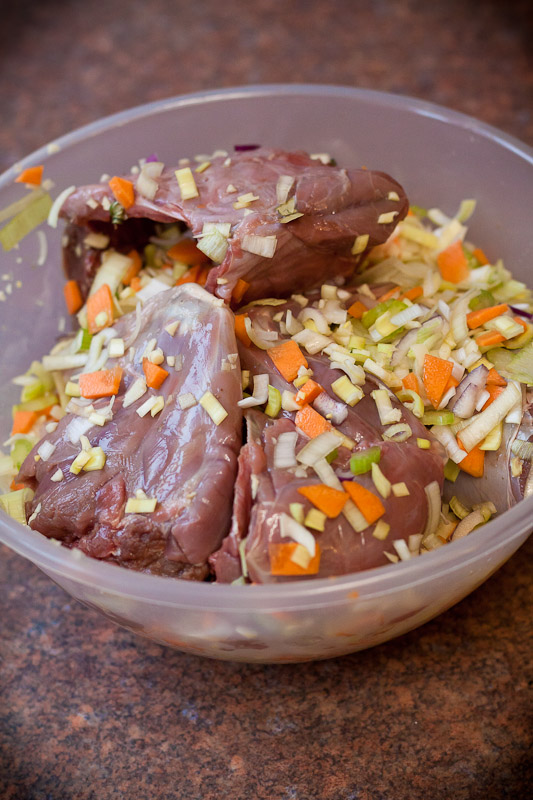
Before going to bed I finely chopped up the veg and aromatics to make a marinade, gave the joints a good coating, mixed up everything and left it overnight to mellow and rest. I then did the same, minus the marinade. Next day I chopped up the last of some wonderfully smokey Porcus backfat and bacon (to keep with the local, hilltop vein), and rendered that down, substituting this for the oil in the recipe. Then the veg got sweated down, accompanied by what few drips of marinade juices were left in the bowl, then in went half a litre of red wine. This took a while to simmer down and evaporate, then I added a dollop of tomato puree and some cocoa.

The addition of cocoa powder might sound a tad unexpected… but after the frankly amazing rabbit with morcilla and chocolate I’d previously cooked, I didn’t need much persuasion to whack a generous teaspoon into the mix. The cocoa-y flavours add a richness with a slight tang, just enough to play off the tomato and sweetness of the veggies. Finally in went the meat, the pot was filled with water, and everything simmered slowly, softening and bubbling away for a few hours until the meat threatened to slip unbidden off the bones. It was at about this time that my guest for the evening, a good mate who’s recently recanted an adult lifetime of vegetarianism, helped me to clean the cooked meat from the bones for the second stage of the cooking. To be honest,  this was above and beyond the call of duty, but he threw himself into the task with more gusto and enthusiasm than many a seasoned carnivore would; driven by a combination of curiosity and hunger. I’d at least warned him that wild beast would be on the menu before he turned up, so it wasn’t too much of a shock for him…

Everything went back in the pot, bar the carcass which was reserved for later use, and the ragu reduced for an hour or so, until it more resembled a dark pulled-pork dish than a normal pasta sauce. By this stage the collective groans of our stomachs ensured the pasta was cooked and garnished. I’d originally intended to dig out the pasta maker and roll out a few sheets of home-made ribbons, but this was a bit ambitious for a midweek work night, so I decided to go with something already in the store cupboard instead. I went for Orecchiette Pugliesi, that curious ear-shaped pasta, reckoning its bite and open shape would work well to catch the thick ragu. It did the trick…

A good helping of pecorino and a twist of parsley topped off the hearty, steaming bowls, and we tucked right in. You know it’s a good meal when there’s little conversation and less left in the dishes by the end. The hare had a big flavour… deeply rich and meaty, with more than a hint of game, but the tastes were balanced rather than overwhelming. Cooking it so slowly meant the meat was soft, succulent and very moist, and had absorbed all the other flavours in the pot, reducing everything down to a dark, unctuous delight. The only criticism is that it was almost too dry for a sauce to coat and accompany pasta… if I made this again I’d take it off the hob slightly earlier.

As is so often the way, the flavour got better over the next couple of days – just as well, as there was a lot of meat on this hare. I was (happily) eating it for days, and there’s still a tupperware container in the freezer, holding at least three generous portions, ready to meets its match with some home-made pappadellle one evening as the nights draw in. And, as the bones were substantial enough to boil up, I’ve also got a good selection of hare stock (or should that be hare restorer?) ice cubes in the freezer, ready to add to something special in the future.

Brown hare are powerful, elegant but shy native creatures – normally the most I see of them is a browny-grey blur when I’m out walking in the hills – so I’m pleased to have gotten a second chance to savour this beast… and that we hit it off better on our second dinner date. I can highly recommend this dish… stop reading this now and make yourself a hare appointment!

Finished potato apple bread

Potato Apple Bread

Finished potato apple bread

I grew up on apples and even though more fashionable and fancy fruits have come along since then, none of them have replaced the apple as well, the apple of my eye. Our grandmother lived near County Armagh – with its world famous apple trees – and had an orchard of her own on the farm that produced beautiful Bramleys in abundance. A visit to her’s wasn’t complete without a slice of apple pie.

Another treat I remember when I used to stay with her in the school holidays was the Ulster classic of potato apple bread. Sheets of stodgy but delicious potato bread, filled with tart apple and fried til golden brown on the outside. It is a total treat at anytime, but particularly tastes of autumn when you could pick the apples freshly. It also used to pop up as a seasonal treat in the bakeries of Belfast as the leaves turned and the school year started.

I always thought it was a fiendishly tricky thing to make until I whipped up a batch of potato bread for the first time a few years ago and realised it’s as easy as falling off a log. It followed that the apple version couldn’t be much trickier. And after getting my hands on some Lambeth apples courtesy of Incredible Edible Lambeth and the London Orchard Project at the new monthly Make It Grow It Sell It market, the time had come to try it out.

Potato bread is traditionally made with leftover mashed potatoes, but if you manage to have leftover mash in your house then you’re a better person than I. Instead I peeled about 300g of Maris Pipers, boiled until tender, drained and dried well and added a knob of salted butter before mashing well. Don’t add milk or you’ll end up with something akin to babyfood with this recipe. The salted butter stops the potato being bland so don’t skip it.

Then add around 3/4 cup or 75 grammes of plain flour into the mashed potato and form a dough. You may need more flour ,depending on the wetness of your spuds. Mix well to form a stiff but malleable dough. Knead for a few minutes to firm it up and try to keep it moving all the time or it sticks to your surface and forms a gluey mess.

While you are making the potato dough, put your apples on to stew down. I like them fairly chunky so don’t chop too finely and don’t add more than a tablespoon of water to them while they cook. I don’t add any sugar as I prefer the tart tanginess of apple than the sweet applesauce vibe. You could add cinnamon or cloves if you like too, but I didn’t bother.

Take about a fist-sized lump of the potato dough and roll out on some greaseproof paper until it’s as thin as you can without it being difficult to work with or likely to rip. Then place on a plate and cover with your stewed apple, leaving a good lip round the edge. But don’t skimp on filling! Then roll out another fist sized lump of dough on the greaseproof paper and place on top of the appley bit and seal well with your fingers making an enclosed sandwich.

Slide into a well-heated oiled frying pan. Give it about 4 minutes either side, but keep an eye so it doesn’t burn. Potato bread seems to stay raw for ages and then cook completely before you’ve even realised. Once golden and gorgeous on either side, I like to eat it as quickly as the insanely-hot apple filling will allow without hurting yourself.

It works really really well. The slightly salted potato brings out the sweet tang of the apples and it makes a perfect breakfast if you fancy a change from standard tattie bread. You can also serve it cooled down for elevenses or an afternoon snack with a big mug of strong tea. There just isn’t a time it’s not utterly delicious. Just make more than you expected: everyone wants seconds of this one!

Roll up for rollmops!

You can tell I’m half Scottish. I love oats, raspberries are my favourite fruit and I never say no to haggis. But the real clincher is how much I heart herring. I adore rolled them in the aforementioned oats and fried or grilled with anchovy and herb butter, but nothing tops the rollmop. Shiny silver herring soused with onion, spices and cucumber in a handy pot? To me it’s a treat of such delight, I’d be more likely to pick up some pickled fish than chocolate if I wanted to cheer myself up…

So when I found myself with a spare kilner jar recently and espied some beautiful herring on the counter at Dagon’s in Brixton Village (just by Honest Burgers for those wondering) I knew the time had come to take the obsession up a notch and make my own rollmops. I got the fishmongers to fillet the fish and practically skipped home to get a-pickling.

I used this Hugh Fearnley Whittingstall recipe as a guide. I soaked the herring in brine for a few hours, which plumps them up beautifully but does produce a fairly unpleasant odour. So open a window if you can. I then sterilised a clean kilner jar in the oven, while I heated vinegar, allspice, peppercorns, finely sliced onion and dill in a pan. The truly revolting smell of warm vinegar will get rid of any fishiness in the house and made me wonder if I shouldn’t just go back to plastic tubs of soused herring in future…

But the satisfaction of rolling the fillets up, filling the jar with vinegar and herbs and spices and sealing it firmly with a snap won out and by the time the fish went into the fridge, I wasn’t sure if I can manage to wait three days for them to be ready. In the end, I got sidetracked by life and didn’t get to them for a week and they were very much worth the extra wait.

Plump as anything, soft as butter and well flavoured, I cut them with the side of the fork, watching them flake apart perfectly and served them on some lightly buttered sourdough from Wild Caper. They were one of those simple lunches that is in actually fact so good you can hardly believe how lucky you are to be eating it at home. Delicately spiced and super flavoursome, there was no contest between these and the usual shop bought.

I’d definitely use the splash of cider in with the vinegar next time as there was just a bit too much rawness to the vinegar for my liking and it clashed slightly with the soft sweet fish. (Do not go all health conscious and skip the sugar in the recipe. You’ll blow your head off otherwise.) Some cucumber would knock this out of the the park mixed in with the onion and I’ll use some homegrown tarragon instead of the dill, because I intend keeping a jar of these beauties in the fridge all the time now. A few minutes effort makes this a simple treat I can’t get enough of, especially served with some potato salad for an ultimate Northern European feast!