Sloe cured salmon and slow cooked goose…

Christmas may be over for another year, but some memories linger on happily. A hot port in front of a roaring turf fire, a proper fry with Coca-Cola ham instead of bacon on Boxing Day and the revelation that was home made gravlaks or home cured salmon fillet. Economical, easy and above all, delicious, I can’t recommend it enough!

As you might have noticed, we at North/South Food have a soft spot for Scandinavian food due to the influence of having family friends in Norway, so it’s no surprise to hear that I got my paws of a copy of Scandilicious by Signe Johansen as soon as I could after it was published last year. Filled with mouthwatering recipes and beautiful photos, I almost didn’t know where to start with this book when on page 151, gravlaks with dill mustard sauce leapt out at me. It might have been September, but I knew what our Christmas Day starter was going to be already.

All the Scandinavian countries cure, pickle and salt fish to improve its taste and to preserve it. Having seen how easy it was to pickle rollmops, I couldn’t wait to get curing, especially when I saw how easy the process is. I used Signe’s recipe as a guide to get the sugar and salt proportions correct, but wanted to add a personal twist. She suggests oomphing up the cure with some aquavit, but I decided to use a family favourite and add a splash of sloe gin instead.

Along with those Norwegian influences, one of my strongest childhood memories is of my parents making sloe gin nearly every autumn. We’d go on family walks in the autumn near my grandmother’s farmhouse searching out blackberries and blackthorn bushes and pick as many of each as we can carry. Back home, everyone would join in the pricking of the sloes before the jars of gin were stashed in the cupboard to mature. It was one of the first tastes of alcohol I had and the sweet, yet sharp flavour made me the gin lover I am to this day. Mister North has carried this tradition on with his legendary damson gin and our mum resurrected it when she managed to get hold of some stunning sloes when housesitting for friends who live on the tip of the Ards Peninsula facing Strangford Lough. Plump, juicy and slightly infused with salt, they made superlative sloe gin. I couldn’t wait to infuse the cure and the salmon with a splash of it.

A salmon fillet was purchased from Tesco as Belfast, sadly, isn’t abundant with fishmongers. Since there were only two of us, we went for half of one side of salmon. We didn’t freeze it first, but this would be advised if you aren’t sure how fresh the fish is or if you’re serving children or anyone with a comprimised immune system. The actual work involved in gravlaks is minimal, but you’ll need to let it cure for up to 48 hours so plan ahead.

I covered a flat baking tray with foil, then covered the foil with clingfilm before laying the salmon on the clingfilm, skin side down and applying a mix of pink peppercorns, coriander seeds, home grown fennel seeds and dill from my mum’s garden to the flesh. I then mixed up the sugar and salt with just enough sloe gin to turn the mix pale pink and make a stiff paste. This went on top of the spiced fish before the clingfilm was used to parcel the fish up tightly. It was all wrapped in the foil and left on the tray to catch any brine and then weighted down well in the fridge, multi-tasking by using the goose we were having for Christmas dinner.

A gift from the same friends on the Peninsula as we sourced our sloes from, this beast rivalled Mister North’s spiced beef for best meat dish of the season. Raised in the family’s walled garden, this goose was free range and more. Killed and plucked especially for us, we’d been looking forward to it for months. Scalded, salted and simply roasted, first in a hot oven to crisp the skin and then on a low heat to cook through, it was plump and juicy and so bursting with flavour that we just couldn’t get enough of it even though there were just two of us.

But it was challenged as dish of the day by the salmon. We usually do a seafood supper on Christmas Eve and to accompany our Lidl lobsters, we had some of the gravlaks on the side. Brushed clean of the peppercorns, sliced thinly and served with some fresh wheaten bread, it was spectacular. So soft it melted in the mouth, unlike slices of packed smoked salmon that remain firmly rubbery, it was moreishly salty sweet and fresh with the aniseed of dill and fennel and we both loved it.

Extraordinarily easy to make and much better value than most smoked salmon, it made a perfect start to Christmas dinner and the ultimate cold cut after the big day, as wafer thing slices of it cried out to snaffled everytime the fridge door was opened. It would make a easy, but impressive centrepiece for a lunch anytime of the year, but after this, I can’t imagine our Christmas without it in future…

Guinness Pumpkin Gingerbread

Christmas isn’t Christmas without the scent and taste of spices in the air and on the tongue. Last year I indulged with doughnuts and mulled cider. This year, my appetite whetted by the parkin, I decided my Christmas spice had to come from gingerbread. I intended to make hard gingerbread people made extra festive with gold leaf, but my dough refused to play ball and I ended up with something more akin to sticky Play-doh. I sought solace in booze and a stack of Nigella’s recipes to see if I could find a foolproof gingerbread recipe.

And lurking in Kitchen, but also available online was the truly tempting sounding Guinness Gingerbread that combined dark sticky stout with dark sticky treacle and spice. I was instantly sold. Except I didn’t have any sour cream or even emergency yoghurt. I didn’t have time to go out and hunt any down (sour cream is surprisingly elusive these days. It’s all creme fraiche instead.) But I did have some leftover buttermilk and half a can of the pumpkin leftover from the ice cream. Despite the lack of success with that, I knew the pumpkin works well in baked goods, adding amazing moisture. Mouth watering, I got baking…

You’ll need:

150g butter
300g golden syrup (or use black treacle if you have it. I did half and half)
200g dark muscavado sugar
250ml Guinness (this is about half a bottle and you can use any stout)

2tsp ground ginger
2tsp ground cinnamon
1/4 teaspoon ground cloves (or as I had none, I used mace)

300g plain flour
2tsp bicarbonate of soda
150g pumpkin or squash puree
150ml buttermilk (or leave out the pumpkin & buttermilk and use 300ml sour cream)
2 large eggs

Then prepare yourself for the easiest baking recipe in the history of the world. Line a 20x30cm deep baking tray with parchment. Then melt the syrup, treacle, sugar and Guinness in a pan. This will smell amazing.

Sift the flour and bicarb and spices into a nice big bowl and then pour in the melted treacle Guinness mix and half combine. Then add in the beaten eggs, buttermilk and pumpkin puree and combine the mixure lightly until just properly mixed. Don’t overbeat or you’ll knock the air out of this beautiful batter. Pour the batter in the lined tray and then bake at 170℃ for around 45 minutes or until the gingebread is a glossy dark brown on top and coming away from the edges slightly.

Then comes the tricky bit. Your house will smell sensational, all spicy and treacly and sweet and you will have to wait at least 20 minutes for the gingerbread to cool and firm enough to get it out of the tray and cut in pieces. This will test your limits. You’ll want to get the kettle on and your chops round a sticky piece of gingerbread sooner, but it is worth the wait.

Unbelievably moist, but firm and springy from that fortifying Guinness and with the most wonderful spicing, this is the stickiest, moistest most Christmassy gingerbread possible. Served slightly warm with a scoop of good vanilla ice cream it would make a great dessert. I iced some of it with simple icing sugar and water mix with a teeny splash of the leftover Guinness to make it more a cake. The un-iced stuff lasted well in a tin, growing softer and stickier each day, allowing you to make this and have it ready for visitors with ease.

Just remember to keep your last piece to put by the stockings for Santa on Christmas Eve. He’ll come to your house first next year after tasting gingerbread this good…

Candied Peel

I love love love candied peel. I used to run to the baking cupboard and cram spoonfuls of it in my mouth when my mum wasn’t looking. It was my favourite bit of any fruitcake or barmbrack. This is especially odd since I don’t like oranges as a fruit, juice or flavouring, and generally eschew citrus fruits of all kinds. But mellow those citrus rinds in vats of sugar and it’s hypnotic to me.

An inability to read recipes a few weeks ago meant I ended up with an overabundance of grapefruits when making marmalade for cake and found myself wondering what to do with them all. A casual Twitter conversation about Christmas preparations brought about a massive lightbulb moment. I would make my own candied peel. Never mind if it was incredibly faffy and complicated: I could rise to the challenge!

Imagine my glee when this Waitrose recipe popped up and I realised candying my own peel was actually easier than pie. Radio on, sleeves rolled up, I set about peeling and de-pithing my citrus fruit. I had a mix of pomelo, ruby grapefruit, lemons and orange, but avoided limes as I thought it might be too overwhelming, like cordial.

Get four pans going on your hob and simmer the peels separately in hot water for about 20 minutes to soften them up. Then split the peels into two pots to simmer in the syrup. I actually made two batches of candied peel and found it easier to keep the peels bigger and cram less peel into the pans as they bubble and soak up the sugar. I just did two batches of the syrup to be sure nothing caught or burned. Keep the heat down low as you can, you only want the merest blip in the syrup to stop it getting bitter or caramelising. Then go off and do stuff while your house smells truly amazing…

I came back to my peel when there was still a tiny bit of syrup left, and lifted the biggest pieces out with tongs, laying them on baking trays. The smaller bits went into a sieve to drip any excess syrup off, as you don’t want so much syrup on the pieces: they dry crunchy and I didn’t fancy trying to boil my pan dry and win the challenge. I then left the trayfuls of peel in the living room to dry as it was the only place I had room, but the airing cupboard or anywhere the cat can’t walk on them will do.

About three days later, I turned the peel with tongs and left for another two or three days or until I remembered about it. I popped it in a ziplock bag, with a tablespoon or so of icing sugar, and shook it up to coat it and stop it sticking together. Some went into the Christmas mincemeat. Some went into cellophane bags to give as gifts. The rest was stored in a jar to be used for various festive recipes closer to the time and the leftover syrup stored for a drizzle cake or put on porridge or ice cream.

So if you didn’t do a cake on Stir-Up Sunday, impress people with homemade candied peel instead. You will never buy one of those tiny tubs again after you’ve tasted the citrus sensation of making your own. It tastes as good as it looks!

Polishing off Polish Pierogi…

Several things are guaranteed to bring a tear to my eye: the episode of ER where Mr Mark Greene dies, posters for lost stuffed animals and family pets and the thought of ever having to go low carb and stop eating potatoes.

I really don’t care how big an Irish cliche I am. I love spuds with all my soul. What other foodstuff is so versatile, so easy to work with and to grow yourself? There is just no thing as too many potatoes in my life and that is why I love pierogi so much. A dumpling stuffed with mashed potato? Hello there! Dumpling is the magic word in my world, especially when you can fry them in butter to add even more of my favourite things to one dish.

There are as many recipes for pierogi as there are types of spuds and Polish families, but I used this one from Post Punk Kitchen as I wanted a dairy free recipe for a friend with intolerances. (I find specifically dairy free sites seems to rely heavily on soy or nut ‘milk’ based products and I would sooner die than use soy cheese. Vegan sites tend to seek other options and skip the processed stuff most of the time so I prefer them.)

I cannot pretend to have solved the eternal dilemma of translating American potato recipes to our varieties and found a total replacement for Yukon Golds, but find that if all else fails, a Maris Piper is the answer, although I used the last of my own Pink Fir Apples from the veg patch. I also won’t lie to you. This recipe is time consuming, but actually very easy to make. So stick Radio 4 on, roll up your sleeves and get pottering in the kitchen this weekend.

First up, choose your filling. Pierogi can be stuffed with anything. You can do some with spud and some with just about anything of your choosing. Sauerkraut is popular. I fancied pumpkin and sage to be seasonal. Black pudding would be brilliant. But feel free to use anything you desire. Leftovers would be perfect here. I went for sauteed mushroom with tarragon and mashed potato. Just cook as you normally would, but make your spuds are nice and dry before you mash them.

Once the filling is decided on, you’ll need to get going with the dough. This is dead easy. An American cup is approximately 240ml which equates to about 110g of flour, but if you’ve got measuring cups, stick to those. I used plain flour here and needed to add all three full cups of flour to stop the dough being too sticky to get out of the bowl. I added another two or three handfuls to it as I was kneading too.

After about ten minutes of kneading, the dough will be smooth as anything and lovely and elastic. This requires little skill, just some concentration and a bit of time. At this point, you can either store the dough overnight covered in the fridge until needed or get on with making dumplings.

Flour the surface and dough well and roll it out as thin as possible. Mine needed to be a tad thinner than they were, but I still got 45 pierogi out of them so be prepared to have an invasion of dumplings! Cut out circles of dough with a cutter or glass and then get filling. I put about a dessertspoonful of mushroom and potato in each one, brushed the edges with water and pinched shut, making sure the ends are nicely closed. That’s it. Super simple. Easy enough for little hands to do too.

Once I’d cut, filled and pinched half the dough, I boiled six or so pierogi in a big pot of water for about four minutes or til they float. You can served them simply boiled or you can take it up a notch by frying them off for a golden crunch. Drain them onto kitchen towel if you’re doing that and then pop into a pan of hot fat. While they fry, deal with the other half of the dough. I used up the full 500g of spuds I mashed and half a punnet of chestnut mushrooms to fill all of them, but could have done with twice the amount of fungi.

Once your dumplings are fried, pop in the oven to keep warm and keep going in batches until you’re ready to eat. I served for dinner, sprinkled with truffle salt and fresh tarragon to keep them simple but dairy free, although they’d be great with sour cream too. The other half went onto lined baking tray to cool and go into the freezer until needed.

So after all that time and pinching, were the pierogi worth it? Oh yes! With bells on. Surprisingly light dough with the smoothest creamiest mashed potato possible, despite not a drop of butter, oil or milk in it, all made better by frying them off. I managed 9 of them before passing out in a carb coma, but managed to go back for more for dinner the next night, adding some pan fried breadcrumbs for extra crunch.

A super easy, surprisingly relaxing recipe to make, I urge you to get your dumpling on as soon as. You’ll have a great meal that will impress anyone straightaway and enough to do several quick dinners when you can’t be bothered to cook another night. Dumplings don’t get better than this!

Poutine

Sometimes only chips will do. And after a Friday night that saw tvdinners and I literally drink Seven at Brixton dry of basil and ginger mojitos before giving Kaff Bar’s excellent £3 version a go, I not only needed chips. I needed turbo charged chips. It seemed like the moment my entire life had been wating for to try poutine

For those of who wondering what kind of shenanigans that is, let me elaborate. Poutine is the unofficial dish of Canada, a religion in Québec, especially Montréal and known elsewhere as chips covered with gravy and cheese curds. It’s not pretty dish, but it’s a glorious mix of carbs, grease and fat best served piping hot and after alcohol has been consumed. A grown up gravy chip.

I’ve never seen it served here and it might seem like a right faff to go to, but luck and a certain amount of planning made it fairly straightfoward. The seemingly tricky bit is the cheese curds. I already had the rennet from previous cheesemaking exploits and have discovered that even the little Sainsburys in Brixton sells unhomogenised Jersey milk. So fresh they squeak cheese curds were only a few minutes away.

While the spuds for my chips parboiled, I scalded the milk, added the rennet and let the curds and whey develop. Dry the curds off in a cheesecloth or muslin and turn your attention to the chips. Having drained the chips, I couldn’t be bothered with all the stages Felicity Cloake suggests here and fried them for five minutes at lowish temperature, before draining on kitchen paper and allowing the oil to get really going.

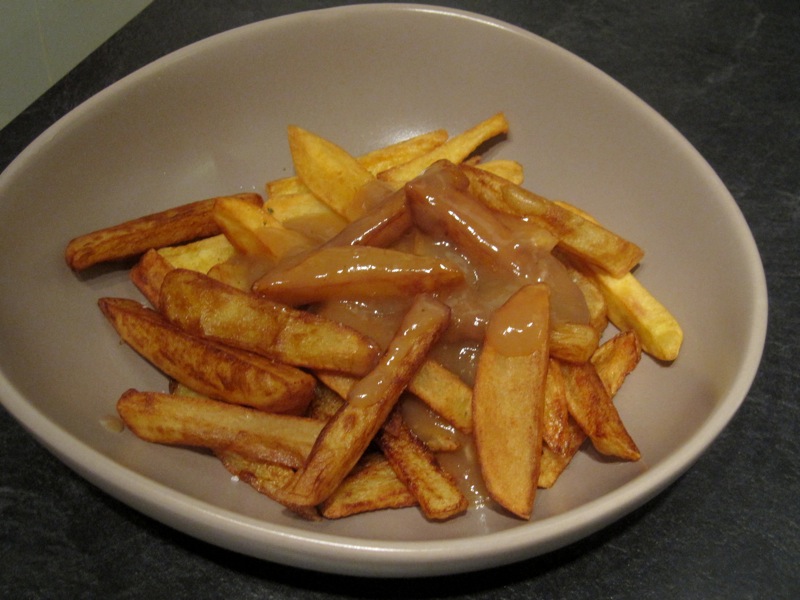
I’d roasted a chicken earlier in the week and by some feat of willpower had the juices left to make gravy with. I thickened it up with cornflour and heated it up. I broke the curds up a bit more with a fork and let drain well before batch frying the chips til very golden. I personally loathe an anaemic chip so relished the opportunity to get these good and Ronseal brown in the hot fat.

At this point I cannot claim how authentic my poutine was. I dusted the chips with salt and pepper, poured the gravy over and then added the curds. I should have done the curds first and then the gravy to make sure the cheese melted more, but I was too hungry to be too bothered. I got stuck in.

And zut alors, I can see why the Quebecois love this dish so much. It’s simple, it’s tasty, it’s filling. It’s soft and crunchy at the same time and cries out to be eaten quickly and while piping hot. The cheese curds melt more like mozzarella than cottage cheese and add a creaminess. The squeak is a little bit like halloumi and the whole thing works like a charm. I loved it.

I’m entering poutine in the Hall of Fame of chip dishes immediately. You might be able to fiddle with it to make it veggie, but my advice is keep it simple and make a date with the dish as soon as you can. The Canadian embassy should start a poutine joint for post pub Saturday nights in the West End. It’d attract more people to visit Canada than all the maple leaves in the world…