Meat Club Manchester. I’ll be honest… they got me at the name… combining a no-nonsense northern sensibility with a degree of intrigue. It conjures up mental images of Brad Pitt and Ed Norton bound by secrecy, or a group of meat traders at New Smithfield Market getting together for a few beers. Conflate the two, add a splash of civility and a heady mix of cooked meat and good booze, and you’ve got some idea of what goes on at Meat Club.
Chef and local food authority Deanna Thomas and her husband Patrick started Meat Club at the start of this year, and it’s grown steadily from a small group in intimate beginnings to this, the fourth in the series. The premise is gloriously simple: invite a local butcher to demonstrate breaking down and preparing the meat of choice, cook and serve it there and then, paired with some great drinks and a heavy dose on conviviality. No standing on ceremony, and every chance to get one’s hands dirty. In one fell swoop it helps banish inhibitions, serves up a double whammy of education and entertainment and showcases great food and drink. All on a school night.
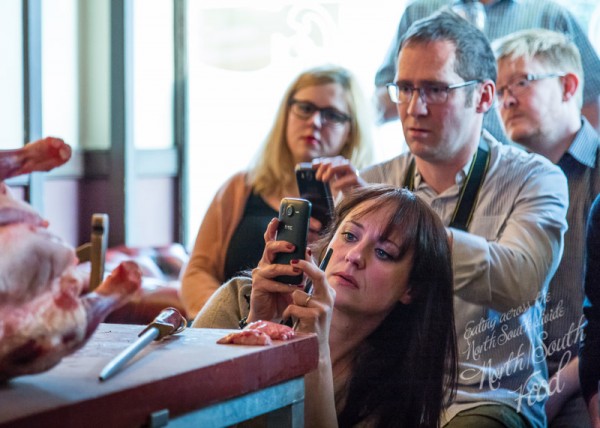
Meat Club #4 was held at the award-winning The Parlour on Beech Road in Chorlton. We arrived early but the venue quickly filled up for this private event, with around 50 guests there to enjoy the hottest carnivorous ticket in town that night… Chorlton butcher Lee Frost introducing us to the pleasures of spring lamb. As it was St George’s Day, the whole evening was themed around quality English fare, with drinks and expertise also on hand from Michael Bush of Nyetimber, and Toby McKenzie of Macclefield’s Redwillow.
If you don’t know him, Lee Frost (Frosty) is a staple on the Manchester food scene. W H Frost’s have an enviable reputation as a supplier of quality meat to many of the best-known restaurants in and around Manchester, and also from their shop in Chorlton. Frosty himself’s a larger than life character, and never one to miss a well-placed pun when it comes to meat, or indeed a well-deserved dig at the major supermarkets. If there was a local meat advocacy badge in the Scouts, Frosty would’ve had it… along with another for meat-based smut. He makes for a highly engaging and entertaining compere.

For a bunch of reasons, life conspired against me going to either Meat Club #1 or #3, but I made it to #2, which was venison-themed and wonderful, again featured Frosty and his knife skills and razor-sharp, smut-edged banter. My better half had to duck out at short notice last time, so I was excited she was able to experience Meat Club herself this time. I reassured her the butchery was not terribly gory, it wasn’t a male-only preserve by any means, and the food would be delicious. Within half an hour of arriving, she was questioning that assertion as the offal flowed.
We enjoyed our first beer from Redwillow, a crisp and refreshing Headless Pale Ale, as the venue engorged like one of Frosty’s metaphors. Outside, faces pressed up to the plate glass windows, obviously curious as to what kind of private function had closed the venue for the evening and involved a sheep’s cadaver in the centre of the room.
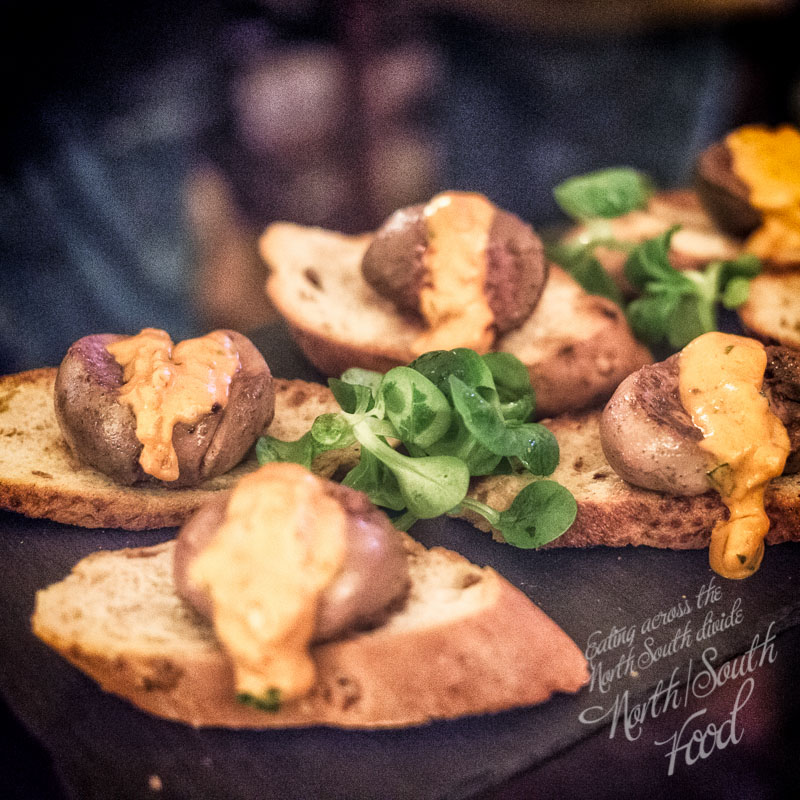
Deanna gave a quick introduction, and then out came the offal. I’m a confirmed offal lover and enjoyed the trio of offally canapés: liver with a boozy red onion marmalade on pastry; gloriously spiced devilled kidneys on toast; and bacon-wrapped sweetbreads (glands in blankets?) paired with cauliflower purée. Mrs North is less convinced of the merits of variety meats. She took a short break and paced herself for the less icky bits. Meanwhile Frosty expertly broke down the lamb with his chopper, regaling the crowd with bon mots, impromptu sales pitches and a maelstrom of interesting facts about bits and cuts. Did you know lambs don’t have bellies (at least not as a cut of meat)? Instead, they have breasts, which extend down to their nethers. Insert punchline here…

After some audience participation butchery, it was time for a touch of sophistication with a glass of Nyetimber’s sparkling wine – in this case a glass of their 2008 Classic Cuvee – and an introductory talk from Mike about the history and ethos of the vineyard. The bubbles in the wine added to the general levity in the room, and reinforced the revelation that there’s a lot more to English sparkling wine than cheap jokes, cheap fizz, and episodes of The Apprentice. This was dry, fresh, crisp, held a hint of meadow fragrance, and was very refreshing. This wine would be ideally suited to a summer’s afternoon, accompanying the sounds of cricket or tennis and some freshly-picked fruit and cream… though we were more than happy to enjoy it in a crowded room in front of a half-dismembered carcass instead.

As a local lad, Lee Frost made the case that Cheshire lamb (in this case the wonderfully-coiffured Texel, originally a Dutch breed) is perhaps the finest in the country. As a Northern Irishman now living in the Pennines, and having eaten some superb Cumbrian Herdwick lamb only the evening before, I’d hedge my bets, though there’s no denying this was one seriously tasty animal. I’d be hard-pushed to select a single best breed or location for lamb in this country, but we live in probably the best country in the world to enjoy this wonderful meat.
Lamb (and mutton) is possibly my favourite meat, and although I know its sometimes strong taste is divisive for more finicky eaters, it’s both a versatile dish and a very natural product. The mere thought of Barnsley chops and Scotch pies make my heart beat a little quicker. Unlike some other ‘farmyard’ meats, it’s hard to intensively rear lamb: if they go beyond suckling they’re naturally free range, and stay healthy and well-toned. Farming sheep is a good way of taking advantage of less productive land, and thus using the meat and wool is an excellent option to support local producers. It’s also part of our country’s shared history: from the upland landscapes, shaped by many hundreds of years of sheep farming, to the symbolic nature of the woolsack in parliament, the British Isles are defined at least as much by our ovine as bovine heritage.

Living in Todmorden, astride the Lancs/Yorks border and the the middle of the Pennines, one is never far from the impact that the lowly sheep’s had on the social and cultural landscape of the north. It’s Lancashire hotpot to the west, and to the east is the rich legacy of the wool trade, on which Yorkshire’s wealth was largely founded before the Industrial Revolution. And yet despite, or perhaps because of, the ubiquity of sheep in the UK, we don’t embrace how lucky we are to have such good produce on hand. These sceptr’d isles provide such a broad range of breeds and pastures that, if you’re able to source decent local lamb, it reflects the characteristics of the land it was raised in… the breed, the minerals in the soil, the grasses and herbs they graze on, and topography itself. That’s why a good piece of salt marsh lamb from Wales, Cumbria or Dungeness is a truly exquisite and uniquely British delight, as is the wilder flavour of a rare breed from an upland farm or croft. Why people buy New Zeland lamb, shipped halfway around the world, when they could enjoy superlative English, Welsh, Scottish or Irish lamb instead, is beyond me. Support local farmers and butchers, please… and take time to rediscover both the cheap cuts and posh joints which can come from a good bit of lamb.

As the main meat cuts were transformed into delicious morsels by The Parlour’s chef Paul and his team in the kitchen, it was hard to dispute this was a superb tasting beast. Delicate slivers of cannon, paired with parsnip purée; chargrilled herb and garlic cutlets, and nut-stuffed breast (not belly, as we now know) provided the meaty accompaniment to the central section of the evening. After nattering about the pleasures of tartare, and how good raw minced lamb can be in Lebanese dishes, Frosty finely diced up some Texel and let me try it. Even unenhanced by seasoning there was a beautifully light grassy flavour, and a sweet note to the meat without any metallic tang you might expect from raw meat. Bloody great.
As we quaffed an introductory bottle of the delightful and very moreable Wreckless Pale Ale, Toby from Redwillow stood up and gave an insight into their beers (I finally found out why they all have names with particular relevance to each type) and how to build an award-winning brewery almost by accident (although I think he’s rather self-effacing… from branding to product quality, this is a seriously professional outfit and they know exactly what they’re doing). We enjoyed a bottle of their Sleepless ale whilst scoffing cute little lamb kebabs and burgers at the close of the evening, before slightly squiffily chatting to others as the crowd dispersed contentedly into the cool night air.
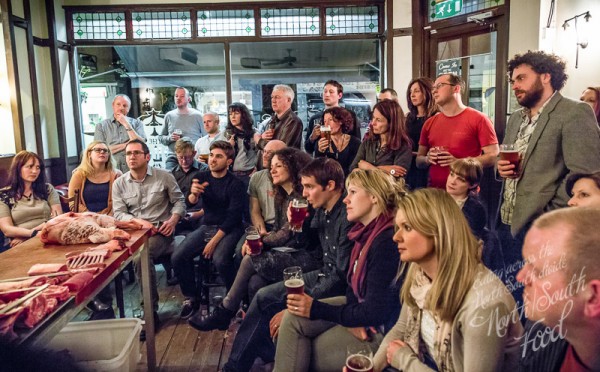
Incidentally, ram’s balls (or fries, as they’re more delicately known) were originally due to make an appearance on the menu, but Frosty explained the abattoir had dropped a bollock, so to speak, and so there was nothing testicular to accompany this young female lamb on the night. An audible ripple of relief resonated round the room upon this news…
I’d highly recommend Meat Club: you might never see as many cameraphones in action in one place as you will here, but it’s a great way to find out more about the journey from field to plate, taste great local food and drink, and to share those experiences with a bunch of others. It’s also getting more popular every month, and spaces go quickly. Wild boar’s next on the menu on the 29th at the Yard in Alderley Edge… more details on their website if you fancy some very boss hog…
-

-
An offally good starter
-

-
Lamb’s liver
-

-
Sweetbreads
-

-
Devilled Kidneys
-

-
Rolled breast
-

-
Cannon and parsnip
-

-
Lamb cutlets
-

-
Lamb kebab
-

-
Lamb burgers